In 2009, Microsoft launched Bing to take on Google. It spent billions over the next few years but Google’s share of search barely moved.
In 2016, Reliance launched Jio to take on India’s telecom companies, with free calls and data for months. Within about two years, a market of over a dozen operators had shrunk to three private players.
Both had deep pockets and both spent big, but only one of them got anywhere.
The difference wasn’t the size of the cheque. It was the kind of moat each incumbent had.
Google’s edge grew with every search: more users meant better results, which brought more users and more advertisers. The telecom incumbents had spectrum and towers, but a richer rival could buy the same (and in Jio’s case, better) airwaves and build more towers, faster.
Deep pockets used to be enough to keep rivals out. In many industries, that’s no longer true, and now AI is chipping away at a lot of other advantages too.
In this newsletter, we will look at which moats are still looking strong and which are becoming weaker.
First, what is a moat?
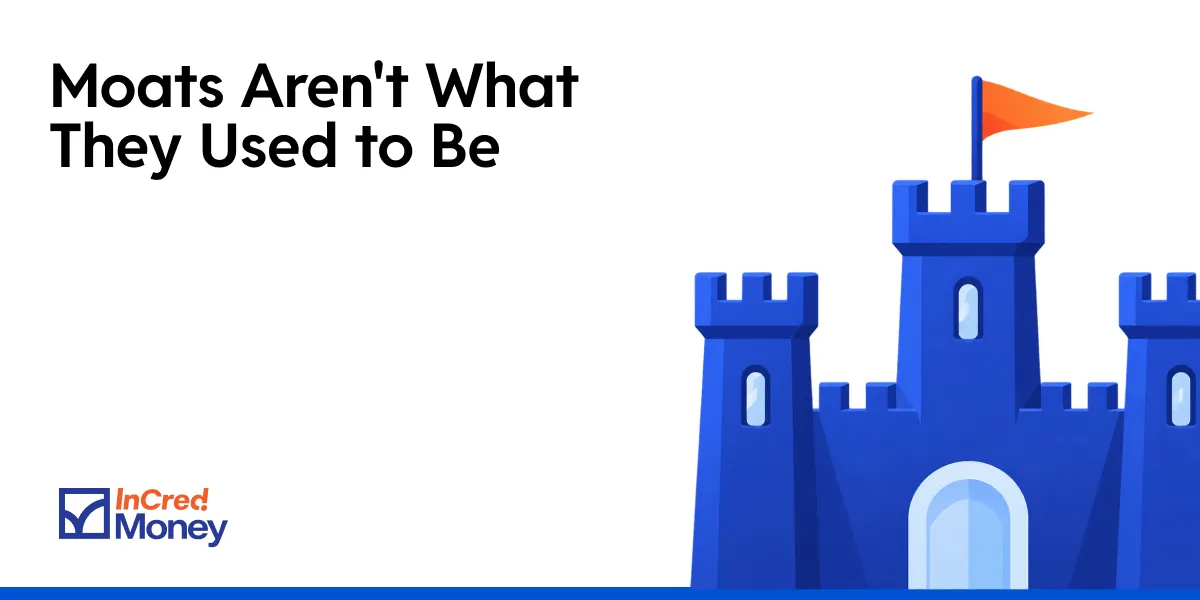
Warren Buffett borrowed the idea from medieval castles. The castle is the business. The moat is whatever keeps attackers out.

For a company, the attackers are competitors. A good product on its own won’t give you a moat. But a moat is what keeps a good product profitable for years.
Why should investors care?
Economics has a simple rule. When a business earns unusually high profits, rivals rush in, add supply and cut prices until returns drift back to normal.
A moat may not stop that pull towards normalised profits but it can slow it down.

This is why moats matter so much for investors. Stock prices depend on how long a company can keep earning above-normal returns, not just how high they are today. The market pays a premium for that staying power, and takes it back quickly when it fades.
Why most moats are getting weaker
Staying on top is harder than it used to be. In 2018, consulting firm Innosight studied how long companies last in the S&P 500. The answer has roughly halved in fifty years.

A few forces seem to be behind this:
- Money is easy to find: Venture capital & private equity can fund a serious rival within a few years.
- Reach is cheap: Instagram, Amazon and quick-commerce apps let a new brand reach millions without needing a distributor in every town.
- Big groups are walking in: Reliance, the Aditya Birla group and others are entering categories that incumbents once had to themselves.
- AI makes hard work cheap: Writing code, making ads and answering customer queries once needed large teams.
Today, if a moat can be bought with money or built by a machine, someone will probably do it.
The moats, then and now
Here are ten common moats, with a tag showing which way each one seems to be heading.
1. Capital – EVOLVING – THE BAR HAS MOVED UP
A few thousand crore once kept most challengers out. But not anymore. Investors will now back almost any credible idea at that scale, which is how India’s quick-commerce companies took on retail chains built over decades.
Where the entry ticket runs into lakhs of crores, though, capital is still a powerful moat. Telecom is the clearest case. The industry that Jio broke into with a massive cheque is now one of the hardest to enter, because the incumbents’ pockets have grown so deep. The same goes for chip factories and AI, where Big Tech is spending hundreds of billions of dollars every year.
Capital is still a moat, but only where the cheque is too big for almost anyone else to write.
2. Distribution – WEAKENING
HUL’s reach into lakhs of kirana stores was once nearly impossible to copy. Quick commerce and marketplaces now let a new brand reach city shoppers in weeks, and Birla Opus showed that even a paint dealer network can be rebuilt with enough money. Next, AI shopping assistants could become the shelf. Now, owning the physical shelf matters less when the shelf lives on a phone.
3. Mass brands – WEAKENING
Awareness can now be bought with an ad budget. That’s how Campa is taking on Coke and Pepsi, and how boAt & Mamaearth were built on social media. Scarcity is the exception: Hermès and Rolex grow stronger by refusing to make enough for everyone. A brand people wait for and not the one that they just recognise is a strong one.
4. Price and cost – EVOLVING
Low prices once came from low wages. But that has no longer been the case. China now wins through scale, automation and supply chains in many sectors from solar panels to electric cars. India has its own version: our pharma companies supply nearly half of America’s generic prescriptions at very low cost. Cheap labour can be copied; scale and systems are far harder to match.
5. Patents and IP – EVOLVING
A patent is a legal moat with an expiry date. Humira by Abbvie, was once the world’s best-selling drug. When cheaper generic copies arrived in the US in 2023 after its patent expired, its sales fell sharply.
A patent protects an idea for about twenty years; it doesn’t protect a business forever.
And now AI is making ideas travel even faster: China’s DeepSeek and then Kimi matched top US models at a fraction of the cost.
6. Trust – HOLDING
Brand is recognition; trust is believing a company will behave well when it matters. In India, few names carry that belief like Tata. Over more than 150 years, the group has become a byword for fair dealing, which is why people buy Tata salt, cars or insurance without a second thought, and give it the benefit of the doubt when it enters a new business. Tanishq, a Tata company, built its jewellery business on exactly that: trust in gold purity.
As deepfakes and AI-made content spread, trusted names may become even more valuable. Trust takes decades to build and one bad year to damage.
7. Know-how – HOLDING
TSMC makes most of the world’s advanced chips, and ASML is the only maker of the machines that print the most advanced ones. Both leaders took decades to build, and the AI boom runs through them. Intel is on the opposite end: it was bigger than TSMC in 2016, before it stumbled in manufacturing.

Know-how takes decades to build and only a few years of complacency to lose.
8. Network effects – STRENGTHENING
Some products get better as more people use them. You’re on WhatsApp because everyone else is. Advertisers flock to Meta and Google because that’s where the users are. In India, traders go where the liquidity is, which is why NSE has the lion’s share in trading volumes. Network effects are the rare moat that widens as a company grows.
9. Switching costs – HOLDING, BUT TESTED BY AI
Some products are simply painful to leave: Apple’s ecosystem, Nvidia’s CUDA software, or Tally for small businesses and their accountants. But AI could weaken this moat by making it cheap to move data to an internal platform and rewrite code, a fear behind this year’s sell-off in software companies. The best moats make leaving painful, not just staying pleasant.
10. Regulatory licences – HOLDING
Some markets allow only a handful of players: stock exchanges, depositories and fund registrars in India, and credit rating agencies globally. The catch is that the regulator can change the rules, as SEBI’s F&O curbs showed. A licence keeps rivals out, but it hands the regulator a say in your profits.
The moat scorecard
Here’s the whole picture in one place, using the same ten moats as above.

What this means for investors
Moats rarely come alone. The strongest businesses often stack several that feed each other. Apple has a brand people wait for, an ecosystem that’s painful to leave, and the cash to outspend almost anyone. Titan pairs Tata’s trust with a jewellery know-how few can match.
So when a company is pitched as having a “strong moat,” look at what’s doing the heavy lifting. If it’s something a richer rival could buy, like shelf space, ad reach or a factory, it’s a head start. If it takes decades to build, like trust, know-how or a network of users, it may be worth paying up for.
The moats worth paying for are the ones money can’t buy.
Vijay
CEO – InCred Money
P.S. I share my thoughts on Investing and the Economy regularly. You can follow me here.