Human biases are eternal. The mistakes people made in the Mahabharat thousands of years ago are the same ones we make today, just with smaller stakes and phones in our hands instead of bows and arrows.
Almost every major character in the epic falls for one kind of flawed thinking or another. Today, we’re looking at two of them: a blind king who couldn’t judge his own son fairly, and the most righteous man in the story, who couldn’t stop chasing a bet he’d already lost. If it happened to them, it can happen to any of us, and it can show up in our portfolios also.
The king who chose not to see – The ownership Trap
Dhritarashtra was the eldest prince of Hastinapura, but being blind from birth, the throne passed to his younger brother, Pandu. When Pandu retreated to the forest, Dhritarashtra took over the throne. After Pandu’s death, he continued to rule Hastinapura while raising both the Kauravas (Dhritarashtra’s children) and the Pandavas (Pandu’s children).
But his deep love for his eldest son, Duryodhan, would eventually be the reason that shaped the fate of the kingdom.
Dhritarashtra watched Duryodhan grow increasingly jealous of the Pandavas and their popularity, strength and claim to the throne threatened his ambitions.
From the plot to burn the Pandavas at Lakshagruha to the deceitful game of dice, he repeatedly failed to stop Duryodhan’s actions. Even after Draupadi was humiliated in his court, Dhritarashtra could not bring himself to firmly punish his son.
He knew exactly what Duryodhan was doing. What he couldn’t do was judge his own son with the same dispassion he would judge a stranger.
Psychologists have a name for this: the endowment effect, more commonly known as ownership bias. The moment something becomes yours, whether it’s a kingdom, or a stock, you stop evaluating it fairly and start defending it.
Daniel Kahneman, Jack Knetsch, and Richard Thaler ran a now-famous experiment in 1990. They handed one group of students a coffee mug each and let another group go without. When they asked the mug owners the lowest price they’d sell for, and asked the others the highest price they’d pay to buy those mugs, the owners demanded almost twice as much as the buyers. The only thing that had changed was that some people now owned it, and that alone made them value it far more.
Source: Kahneman, Knetsch & Thaler, “Experimental Tests of the Endowment Effect and the Coase Theorem,” Journal of Political Economy, 1990.
One example of this bias is for the stock that you have researched heavily. After spending a lot of time studying a company before buying, the effort itself creates a sense of ownership over the idea, and not just the investment. Selling the shares when things are unfavourable would mean admitting that the research led nowhere, so people hold on to defend their work as much as their investment.
The dice game that should have ended after one roll – The Escalation Trap
Yudhishthir was the eldest of the Pandavas, the king who was supposed to embody righteousness above everyone else.
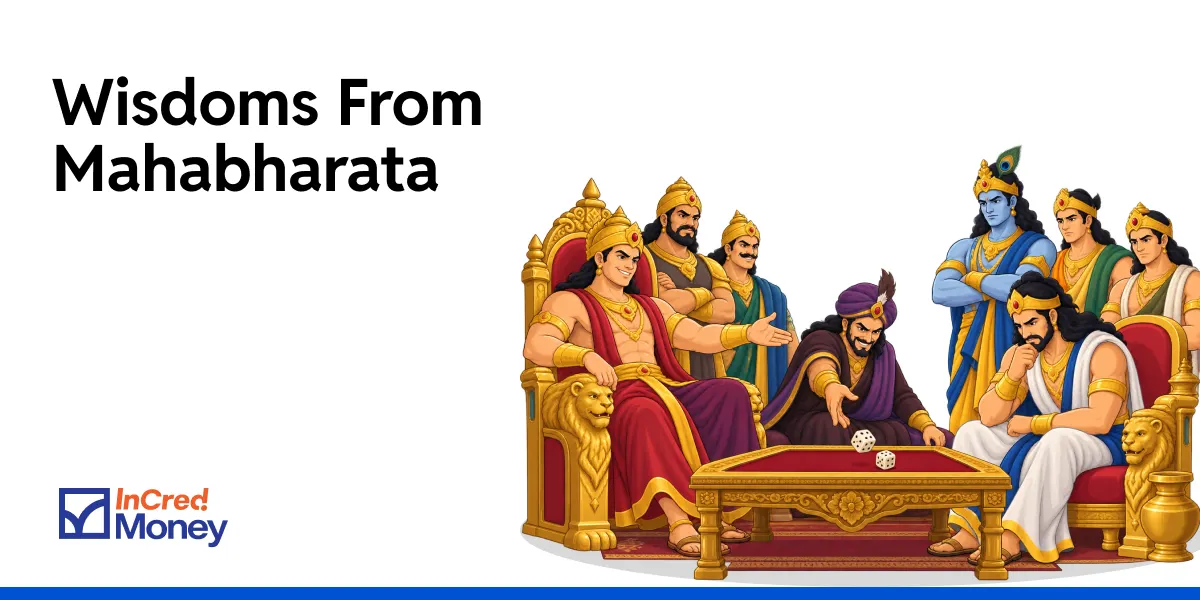
Despite that, he was unable to say no to a game of dice with Shakuni, Duryodhan’s uncle and a great manipulator. What started as a wager over wealth escalated within hours. He kept increasing his bets more and even bet his kingdom, which he lost.
Instead of walking away, he kept playing, because accepting the losses felt worse than risking one more roll to undo them. He bet his brothers, one after another, and lost each one. He bet himself, and lost that too. Then, he bet Draupadi, the shared wife of all five Pandavas, and lost her as well.
There’s a term for this pattern: the sunk cost fallacy, along with its more stubborn cousin, escalation of commitment. Once we’ve poured something into a losing cause, whether it’s money, time, or pride, we tend to justify the next step by what we’ve already spent rather than by whether it still makes sense going forward.
Yudhishthira didn’t bet Draupadi because he thought it was a sound wager. He bet her because everything before it had gone wrong, and one win was supposed to fix all of it at once. The next bet is rarely justified by new information. It’s justified by how much has already been lost.
Picture a stock you bought at 100 rupees because you believed in the company. It slips to 80, and the reason you bought it hasn’t really changed, so you buy more to bring your average price down. Then it drops to 60. Now something feels different, the company’s numbers are weakening, but instead of stepping back, you buy even more, because selling now would lock in a painful loss and a lower average price is your way of telling yourself that this is an easier position to recover now. At 40, you’re no longer investing in a company. You’re trying to rescue the money you’ve already put in.
The cleanest way to think about it is this: whatever you’ve already put in is gone regardless of what you do next. The main question worth asking is whether buying more makes sense from here, starting today, as if you were looking at the stock for the very first time.
The takeaway
The difference between a good investor/ trader and a great one is how they control their behaviour biases. It turns out that it is easier said than done.
Dhritarashtra and Yudhishthir aren’t minor characters written in to teach a quick lesson. One was a king who spent long stretches agonising over right and wrong. The other is the character the entire Mahabharat holds up as the standard for dharma. Neither man lacked intelligence or values. But still they fell prey to a few human biases which then set the direction of the Mahabharat.
Intelligence didn’t protect them, and it may not protect us either. What helps is that by knowing these traps and with some self awareness, we can spot them while there’s still time to step back.
Till the next time,
Vijay
CEO – InCred Money
P.S. I share my thoughts on Investing and the Economy regularly. You can follow me here.
Disclaimer: The Logos displayed above belong to the respective company(ies) and do not belong to us and are used for representation purpose only. We do not make warranties as to the quality of the company, disclosures, IPO timelines, valuations or any other matter. It is specifically informed that if you enter into the buy transaction, it shall be on the basis that you have understood and agreed that we and/or our group company/ies shall be the counterparty to the transaction and you shall have no objections to the same at a later date. InCred Money and its representatives are not SEBI-registered analysts or advisors. Any decision to invest or not to invest shall be at your own discretion. Carefully read and understand the risk profile and disclosures of unlisted equities before investing. InCred Money is the brand name of ETA Fintech Private Limited. Pre-IPO shares are unlisted securities, but this should not be interpreted as InCred Money guaranteeing or confirming that an IPO will take place for these shares. The decision to proceed with an IPO is entirely at the discretion of the issuing company, which may choose not to go public. We do not make warranties as to the quality of the company, disclosures, IPO timelines, valuations or any other matter. The information mentioned on the platform is based on publicly available data and to the best of our knowledge, does not constitute insider information. Detailed Disclaimer