On 3 November, Americans vote in an election that will not change their President. Donald Trump still has two years left but what it can change is whether he spends those two years governing or defending.
The election in question is the US midterms, where Americans vote for the two chambers of their Congress: every seat in the House of Representatives, and about a third of the Senate.
An American President with a friendly Congress and one without are almost different jobs which can impact the US & Global economy and hence the financial markets as well.
Their two Houses, and ours
The US Congress has two chambers, and if you know how Parliament works in Delhi, you already know most of this.

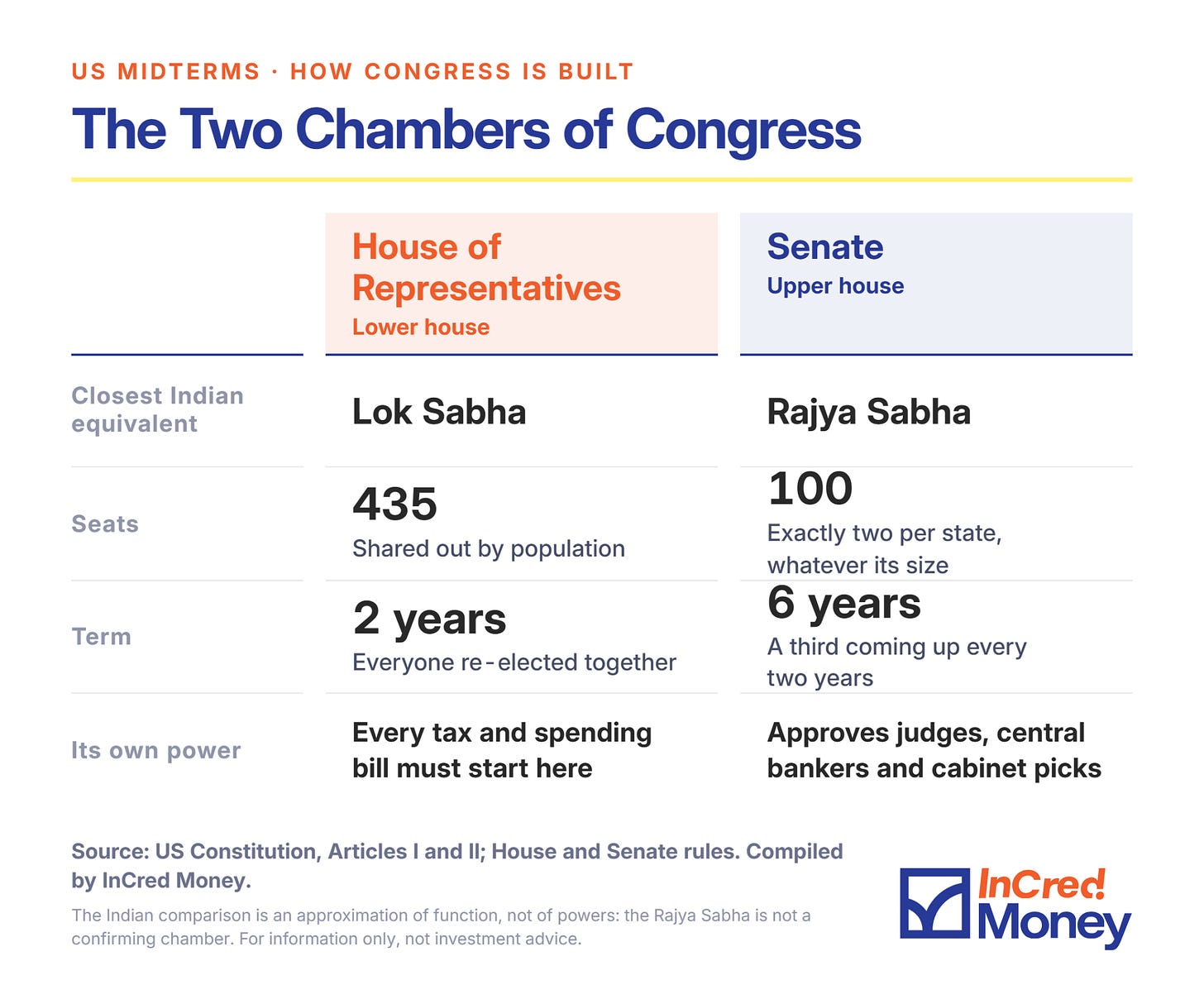
The Rajya Sabha comparison holds up well. Six-year terms with a third retiring every two years is exactly our Upper House, and money bills starting only in the Lower House is our rule too.
The differences are worth knowing. American Senators are elected directly by voters, while our Rajya Sabha members are chosen by MLAs in the state assemblies. The Senate gives every state exactly two, which means Wyoming with under six lakh people carries the same weight as California with 3.9 crore.
The House controls the money, so losing it means budget fights. The Senate controls appointments, so losing it means a President cannot put his people in place. Kevin Warsh was confirmed as head of the US central bank in May, almost entirely along party lines. That vote might not have passed in a Senate controlled by the other side.
Where the seats sit today

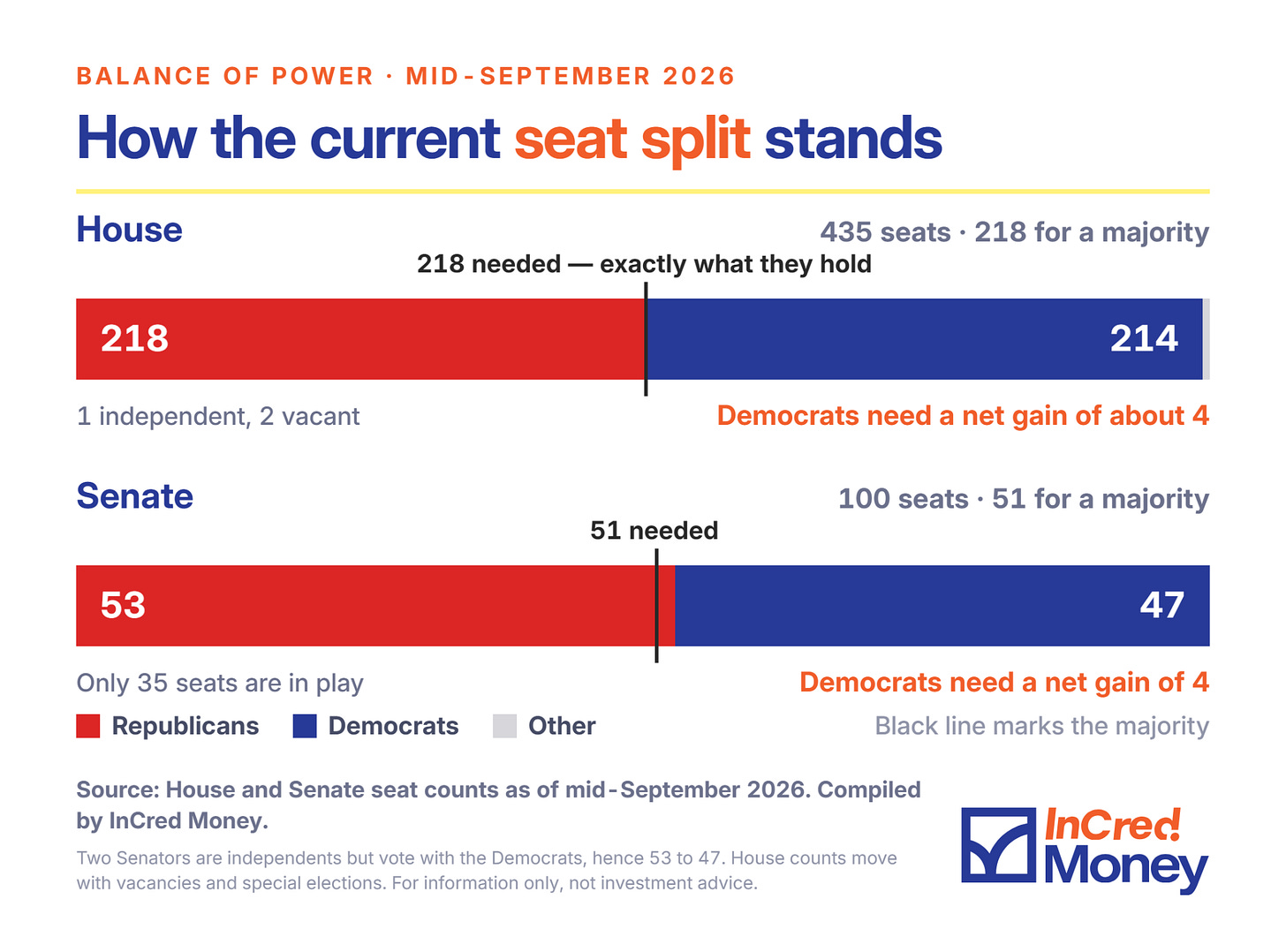
Only about a third of the Senate is up for vote, so the Democrats have to find their four seats inside a much smaller set of races. That is why the Senate is the harder of the two even when the national mood favours them.
Postal and early voting runs for weeks, counting starts on 3 November, and the new Congress is sworn in on 3 January. A close result may well mean a fortnight of not knowing who won.
The President’s numbers have slipped badly
Trump began this term with roughly four in ten Americans approving of his performance. He is now well below that.

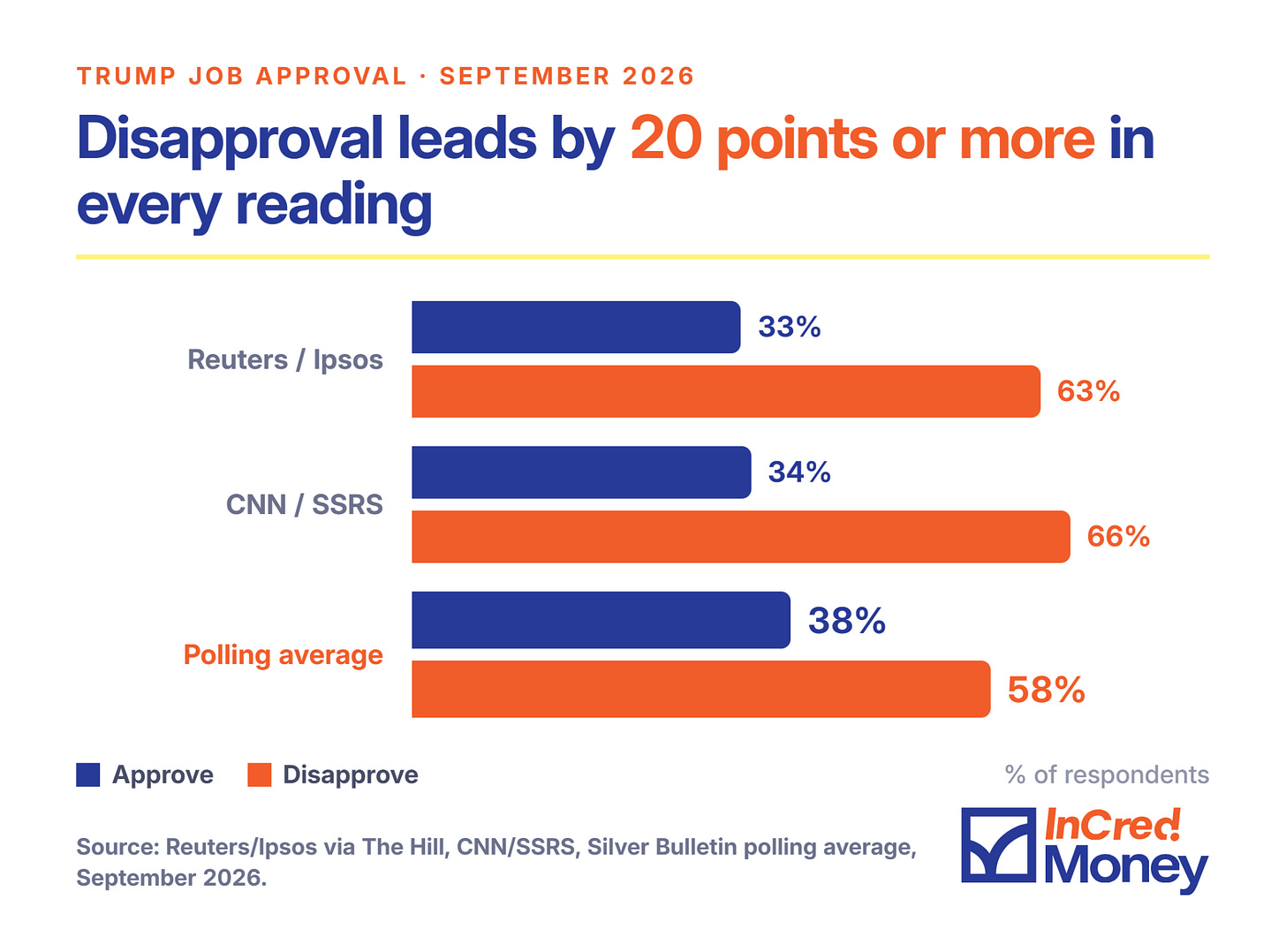
The cause is not foreign policy. It is higher prices and inflation. Cost of living has topped voter concerns all year, and voters do not think it is being handled well.
For the first time since 2010, American voters say they trust the Democrats more than the Republicans to run the economy. For a party built on being the pro-business option, that is a real reversal. History is unkind here too: the President’s party has lost House seats in nearly every midterm since the Second World War.
Four scenarios – What the markets are pricing
Prediction markets, where people bet real money on outcomes, have moved sharply towards the Democrats over the past year. The two largest are Kalshi and Polymarket, and this is where they stood this weekend.

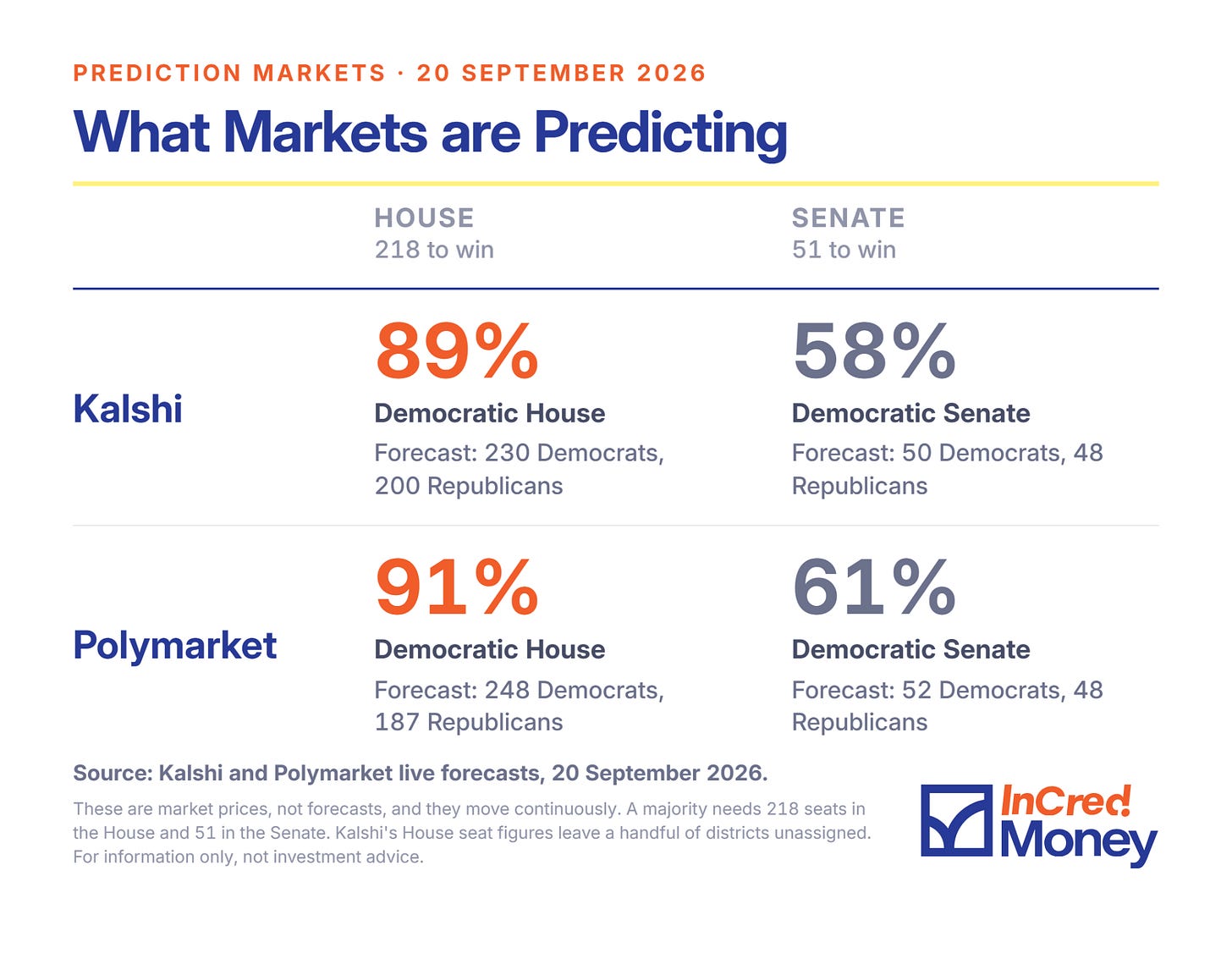
The two agree on direction but differ on scale. On the House they are close on probability, 89% against 91%, but eighteen seats apart on the likely result, which is the difference between a narrow majority and a comfortable one. On the Senate, both put the Democrats around 60%, yet neither central forecast clears the 51 seats needed to actually control it. That is not a contradiction. It means the Senate will go right down to the wire, with enough uncertainty to tip either way.
There are four possible results, all with a very different degree of probability.

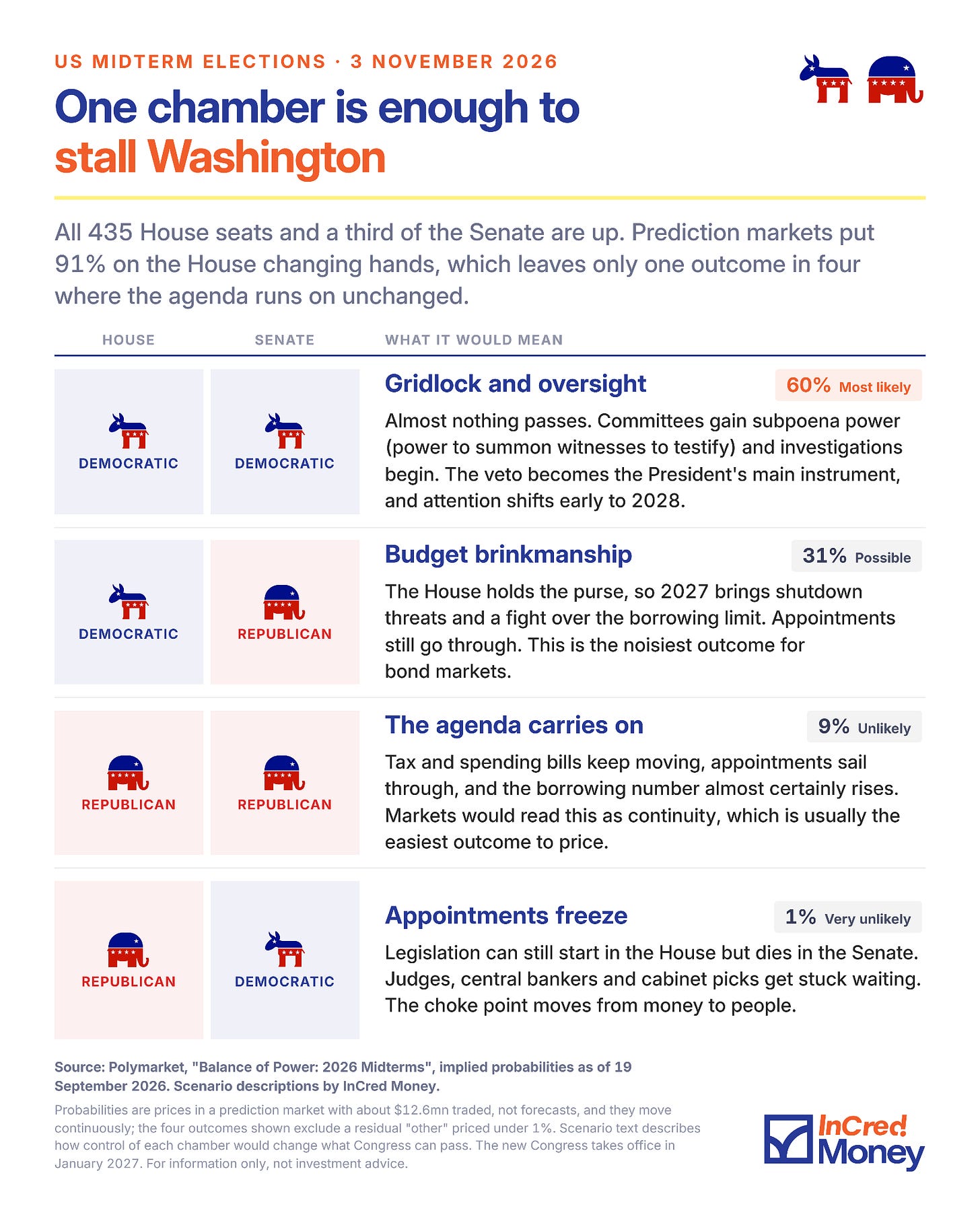
If the likeliest result happens
Lawmaking mostly stops
For any new law, both chambers have to pass the same thing and the President has to sign it. If the two sides disagree, nothing moves. Parts of the tax cuts passed in 2025 run out in 2027, and there would be no realistic way to extend them which means it would just expire.
The budget turns into a standoff
Two things happen in America that have no Indian equivalent.
The first is a government shutdown. In the US, Congress has to actively approve spending, and if it does not, large parts of the government simply stop. Offices shut, staff go unpaid, services pause. It has happened more than once and it can last weeks.
The second is the borrowing limit. American law puts a ceiling on how much the government can borrow, and Congress has to vote to raise it. If it refuses, the government edges towards not paying its bills. It has never actually defaulted, but the brinkmanship rattles markets every time.
A House controlled by the opposition makes both of these likely in 2027.
Why that reaches your portfolio
When Washington looks chaotic, investors demand a higher return to lend money to the US government, so US bond yields rise. Because those bonds are treated as the safest asset in the world, a higher return there makes everything else look less attractive by comparison. Foreign investors pull money out of markets like India and park it in the US instead. That is the real channel through which an American election reaches you: not tariffs, but FII outflows and a weaker rupee.
On tariffs
The tariffs already in place were imposed using powers that Congress gave the President decades ago. To take those powers back, Congress needs a two-thirds majority in both chambers, which no party is going to have. So the tariffs are likely to stay.
What this means for you
If you hold US Equities or funds, the weeks before November may be volatile without heading anywhere in particular. Once the elections conclude, we may see a relief rally just on the back of uncertainty fading away.
If you hold mostly domestic Indian businesses, it will be the rupee-dollar and US bond yields dynamics that will impact us rather than anything political. A messy American budget fight in 2027 would show up in Indian markets through reduced foreign flows.
If you hold Indian exporters with US revenue, trade policy is the main question, and it could potentially stay unsettled well into 2027.
Most of us cannot do much about any of this and can only hope that the global uncertainty of the last two years starts to settle.
Till the next time,
Vijay
CEO – InCred Money
P.S. I share my thoughts on Investing and the Economy regularly. You can follow me here.
Disclaimer: The Logos displayed above belong to the respective company(ies) and do not belong to us and are used for representation purpose only. We do not make warranties as to the quality of the company, disclosures, IPO timelines, valuations or any other matter. It is specifically informed that if you enter into the buy transaction, it shall be on the basis that you have understood and agreed that we and/or our group company/ies shall be the counterparty to the transaction and you shall have no objections to the same at a later date. InCred Money and its representatives are not SEBI-registered analysts or advisors. Any decision to invest or not to invest shall be at your own discretion. Carefully read and understand the risk profile and disclosures of unlisted equities before investing. InCred Money is the brand name of ETA Fintech Private Limited. Pre-IPO shares are unlisted securities, but this should not be interpreted as InCred Money guaranteeing or confirming that an IPO will take place for these shares. The decision to proceed with an IPO is entirely at the discretion of the issuing company, which may choose not to go public. We do not make warranties as to the quality of the company, disclosures, IPO timelines, valuations or any other matter. The information mentioned on the platform is based on publicly available data and to the best of our knowledge, does not constitute insider information. Detailed Disclaimer