Indians have always invested in real estate. But it has almost always been the same kind: residential property.
While the rent on a flat may look high in absolute terms, the rental yields across Indian cities sit at roughly 2% to 4%. Appreciation has been real in some cities and close to not substantial in many others. And there is a lot of hassle: managing tenants, brokers, repairs, society dues, and if you want to sell, it may take months before you’re able to close the deal.
Commercial property solves some of these problems. Office campuses leased to large corporates on multi-year contracts yield considerably more. But almost no retail investor owns any, for two obvious reasons: the ticket size runs into crores, and selling is even harder than selling a flat.
A REIT helps you invest in commercial property without either problems. And two things have put them back in focus this month: India’s first REIT mutual fund has been launched, and Embassy REIT will soon join the Nifty 500 and the Nifty Midcap 150.
And this is why, in this newsletter, we are exploring REITs.
What exactly is a REIT
A REIT, or Real Estate Investment Trust, is a trust that owns finished, rent-earning commercial property and lets you buy a slice of it on the stock exchange. You are not buying a flat. You are buying a share of buildings that already have tenants paying rent.
The closest thing you already know is a mutual fund. A mutual fund pools money from many investors and invests in a basket of shares. A REIT does exactly the same thing with buildings.
While REITs were launched in the US in the 1960s and have since become very popular, India formalized its regulations just in 2014. It took five years for the first one, Embassy Office Parks, to be listed in 2019. Since then 5 more have been listed on the exchanges.

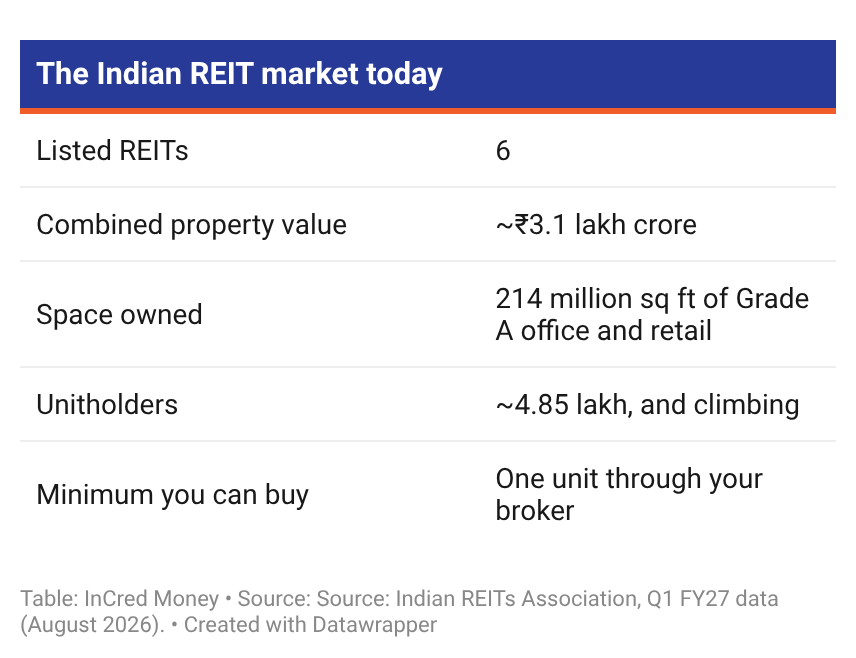
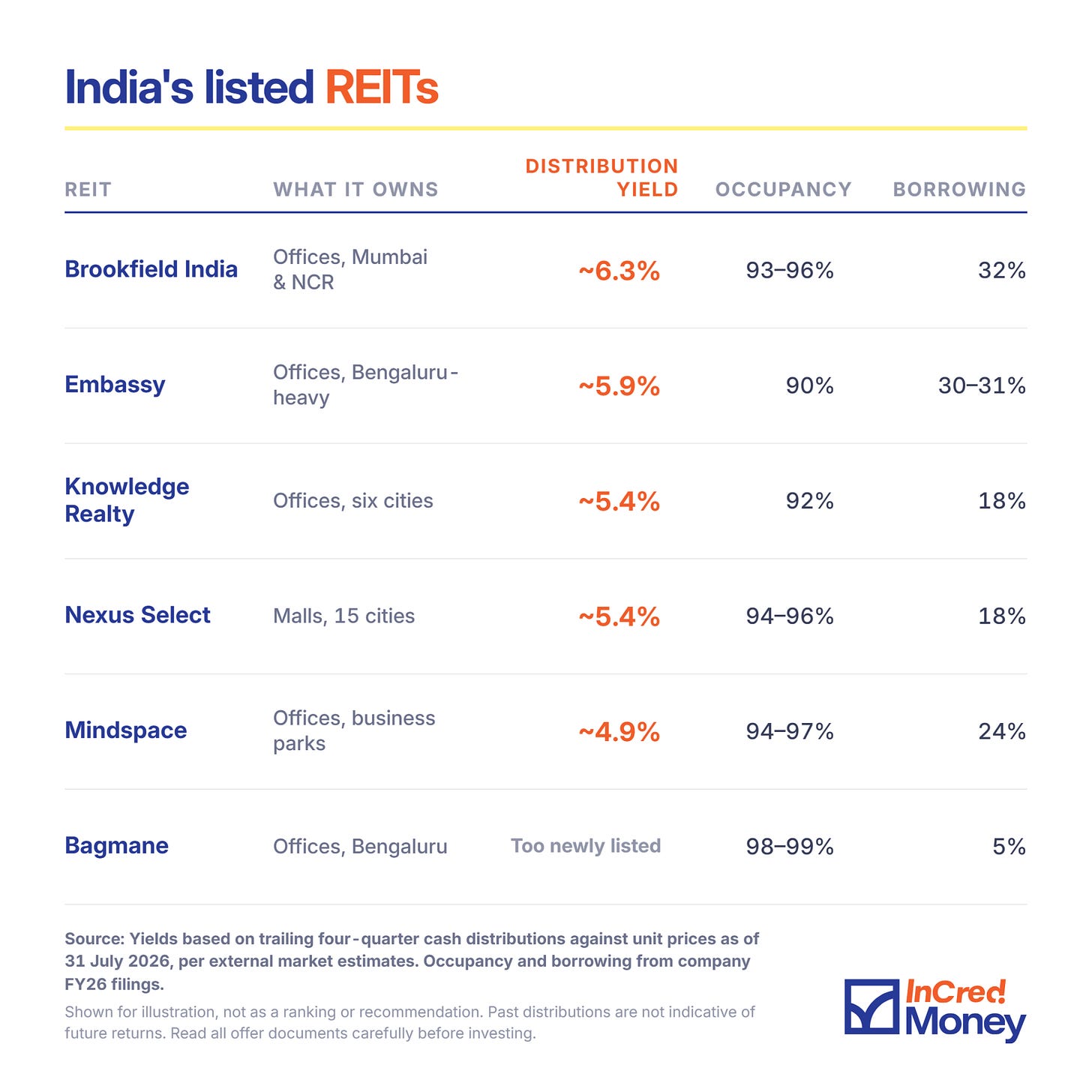
The six REITs, at a glance
Two SEBI rules that shape how REITs function:
- At least 80% of what a REIT owns must be finished, & rent-earning property, not land banks or half-built towers.
- At least 90% of the cash it generates must go back to unitholders, almost always every quarter.
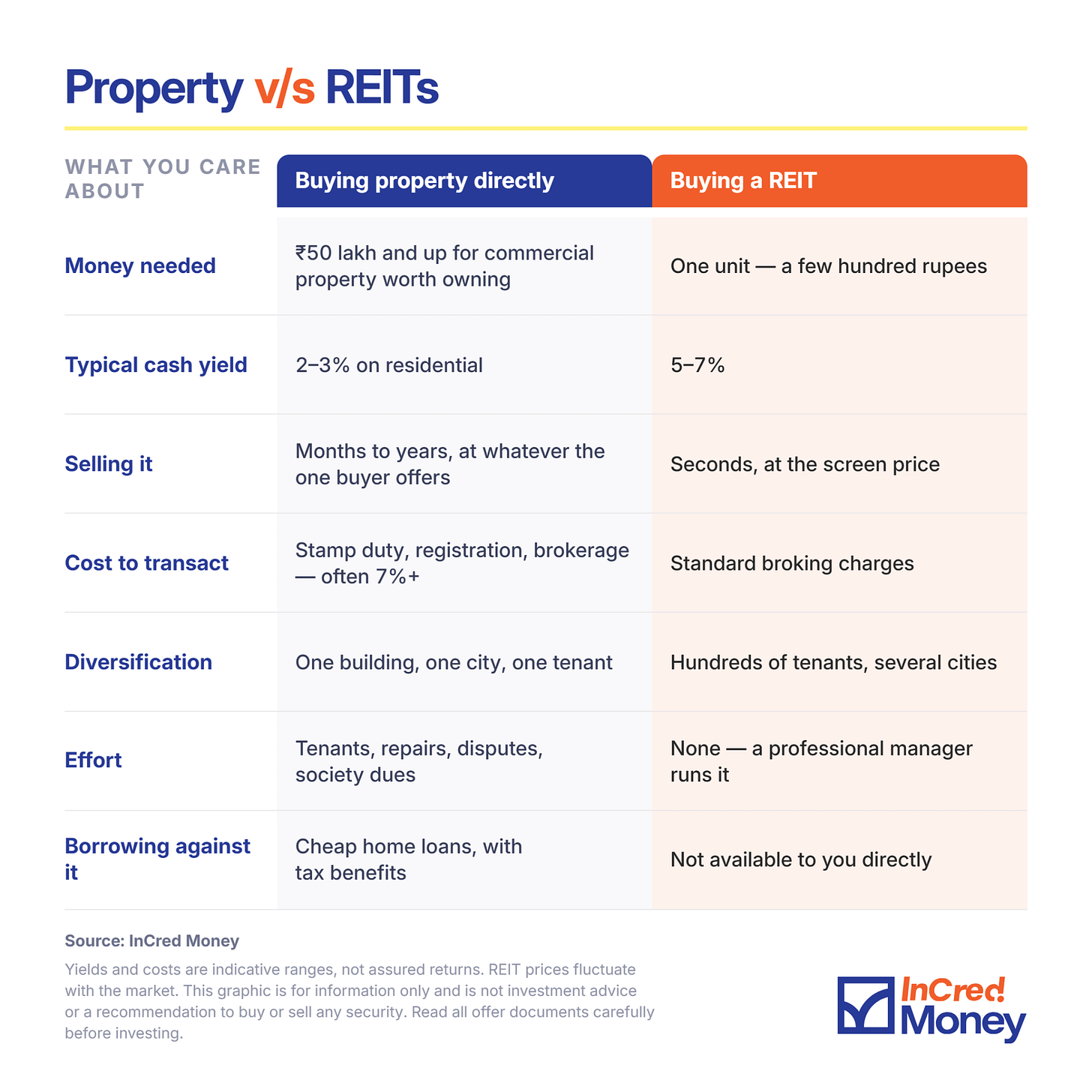
REITs V/s buying a property yourself

How the money actually moves
Picture a REIT called Bluewater Business Trust. It owns three office campuses, each held through a separate company it controls, with an independent trustee overseeing the structure and a manager running operations.

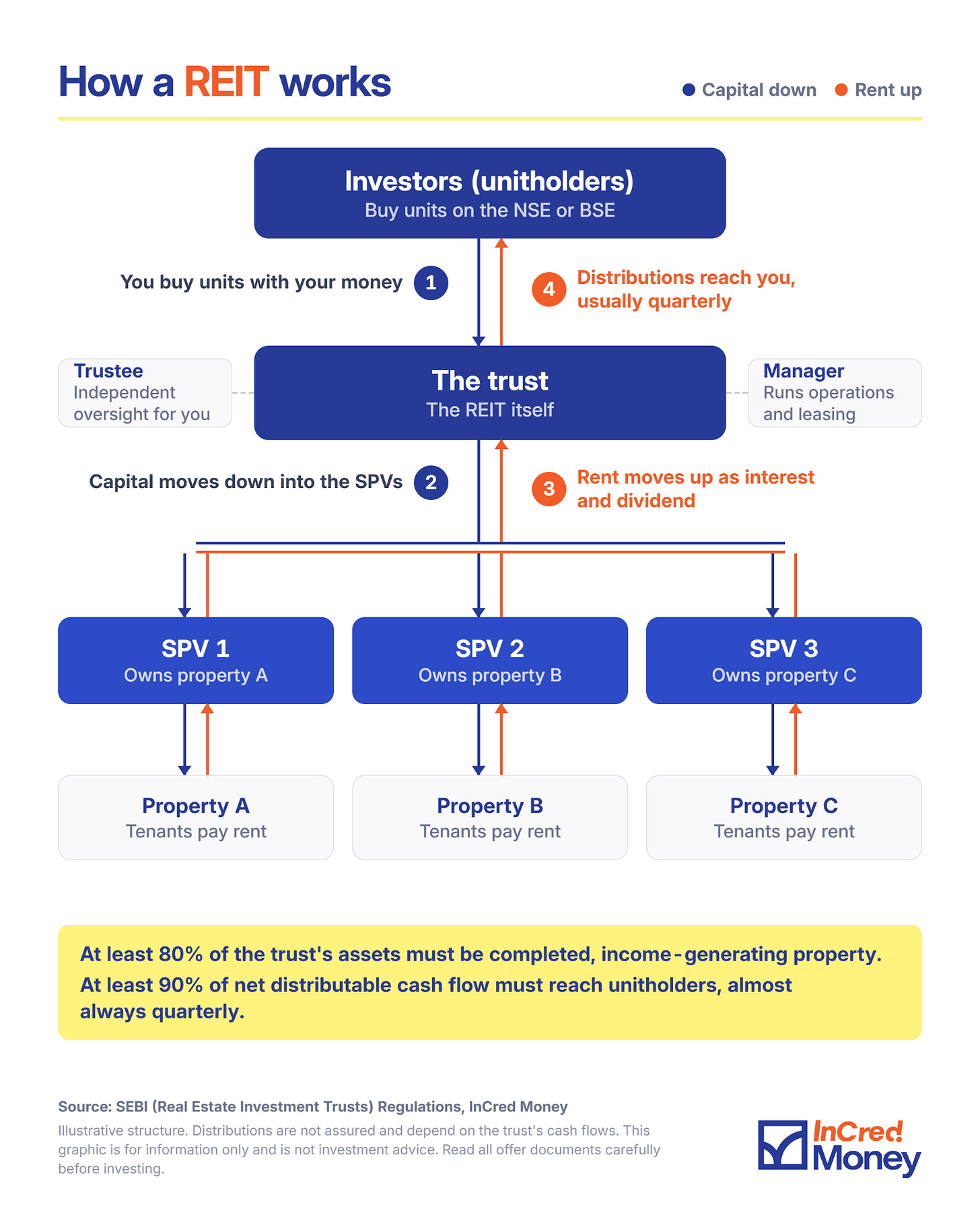
Note: A Special Purpose Vehicle (SPV) is a separate legal entity created for a specific, limited purpose, often to hold assets, raise funds, or isolate financial risk.
Let’s understand how a REIT distributes cash to you through this example of one quarter’s operations. Bluewater owns 5 million sq ft, of which 92% is occupied, at an average rent of ₹85 per sq ft a month.

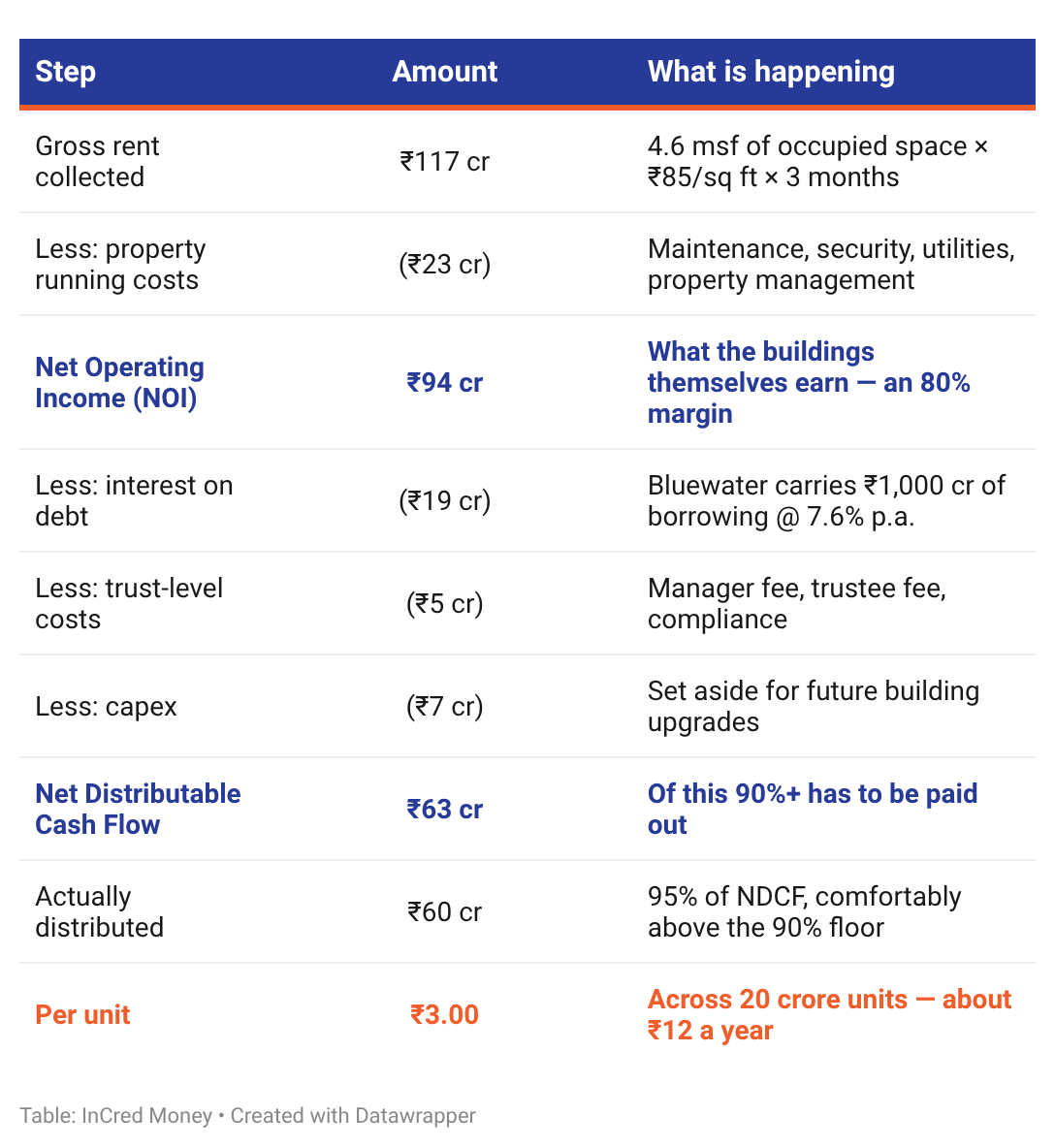
If Bluewater’s units trade at ₹180, that ₹12 a year is a distribution yield of about 6.7%.
The five numbers worth checking
Every line in that table maps to a metric you will see in a REIT’s quarterly results. Here is what each one tells you, using the Bluewater example.

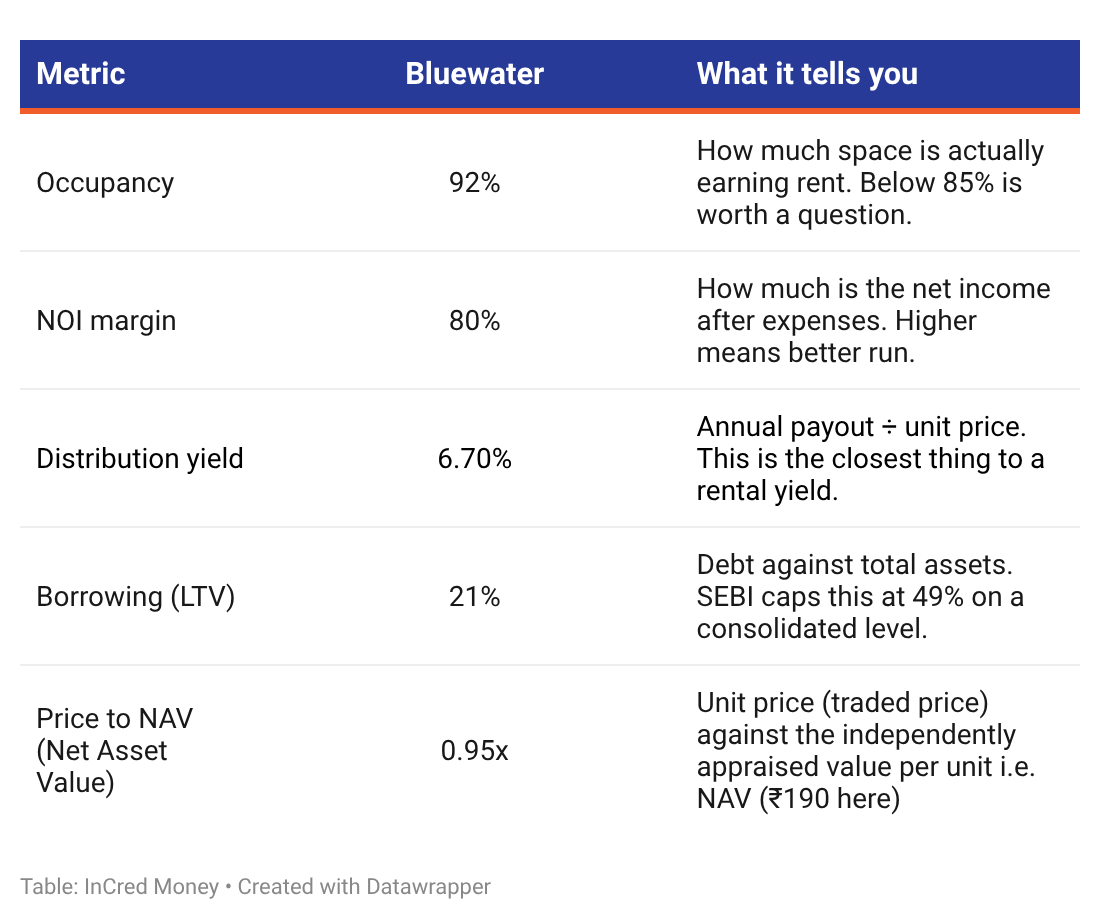
A high distribution yield is not automatically the better buy. It can easily signal heavier debt, or less market confidence in the REIT future growth. Read the yield alongside occupancy, borrowing and a few other metrics.
Also, the distribution (i.e ₹3 per unit in this case) is paid to you in multiple parts. Some part is interest, some part is dividend, and the rest is simply your own capital coming back.
Why REITs move with the rate cycle
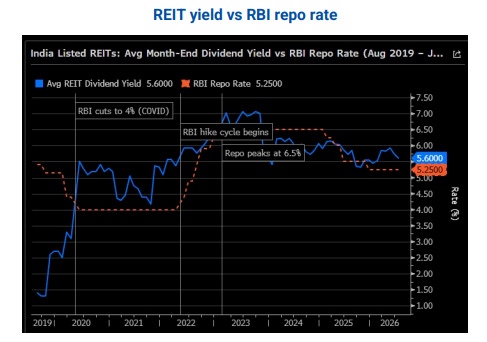
REIT prices are sensitive to interest rates. A REIT is essentially a stream of rental income. So when interest rates fall, safer alternatives like fixed deposits and bonds pay less, so a 6% rental stream looks more attractive and buyers pay more for it (i.e. REIT prices go up). And vice-versa.
You can see it in the chart below. Indian REITs had a difficult 2022 and 2023 as interest rates climbed and hence the REIT payout yields also rose (note that when REIT prices fall, yield goes up and vice versa). The yields fell through 2025 (leading to a price rise) as the RBI began cutting interest rates.

Taxation of REITs
There are two separate things to tax: the quarterly payout you receive, and the capital gains when you sell.
1. The quarterly payout
That ₹3 per unit is a mix of three things, and each is taxed differently.
Interest: At your slab rate
Dividend: Taxable at slab rates (unless the SPVs are in old tax regime in which case, dividend would be tax exempt)
Return of capital: Not taxed now. It lowers your cost price, so you pay later when you sell
Your REIT tells you this split every quarter, so you are not left guessing.
2. The profit when you sell
If your ₹180 unit becomes ₹210, that ₹30 gain is taxed as capital gains:
- Held over 12 months: 12.5%
- Sold within 12 months: 20%
What to take away from all of this
REITs solve a real problem. They give you exposure to commercial real estate which is professionally run and properly diversified. All that at a higher yield, lower ticket size or quick liquidity.
But there is a trade-off. Because a REIT is listed, its price moves every day, and it will swing more sharply than the underlying property market. Physical real estate looks stable partly because quotes don’t change every day.
Also, REITs are not an equity substitute and should not be judged like one. A reasonable long-term expectation might be somewhere around 9% to 12% annualized returns, made up of a 5% to 7% distribution plus modest growth in the value of the buildings. For an investor looking to diversify, REITs provide a genuinely good alternative.
Till the next time,
Vijay
CEO – InCred Money
P.S. I share my thoughts on Investing and the Economy regularly. You can follow me here.
Disclaimer: The Logos displayed above belong to the respective company(ies) and do not belong to us and are used for representation purpose only. We do not make warranties as to the quality of the company, disclosures, IPO timelines, valuations or any other matter. It is specifically informed that if you enter into the buy transaction, it shall be on the basis that you have understood and agreed that we and/or our group company/ies shall be the counterparty to the transaction and you shall have no objections to the same at a later date. InCred Money and its representatives are not SEBI-registered analysts or advisors. Any decision to invest or not to invest shall be at your own discretion. Carefully read and understand the risk profile and disclosures of unlisted equities before investing. InCred Money is the brand name of ETA Fintech Private Limited. Pre-IPO shares are unlisted securities, but this should not be interpreted as InCred Money guaranteeing or confirming that an IPO will take place for these shares. The decision to proceed with an IPO is entirely at the discretion of the issuing company, which may choose not to go public. We do not make warranties as to the quality of the company, disclosures, IPO timelines, valuations or any other matter. The information mentioned on the platform is based on publicly available data and to the best of our knowledge, does not constitute insider information. Detailed Disclaimer