Every animal on earth has solved the same problem.
When a deer hears a rustle in the bushes, it has two choices. Assume it’s a predator and run. Or assume it’s the wind and keep grazing.
If it runs and there was no predator, the cost is a few minutes of lost grazing. Mildly inefficient.
If it keeps grazing and there was a predator, the cost is its life.
Over millions of years, the deer that was wired to run first and ask questions later survived. Evolution ran this experiment across every species on earth and returned the same answer every time: the two errors are not equal. One is recoverable. The other isn’t.
Pulak Prasad, founder of Nalanda Capital and author of What I Learned About Investing from Darwin, makes this case directly: the portfolio works exactly like the deer. Most investors, he argues, are grazing when they should be running.
Errors of Commission vs Errors of Omission
In statistics these are called Type 1 and Type 2 errors. In investing they have cleaner names.
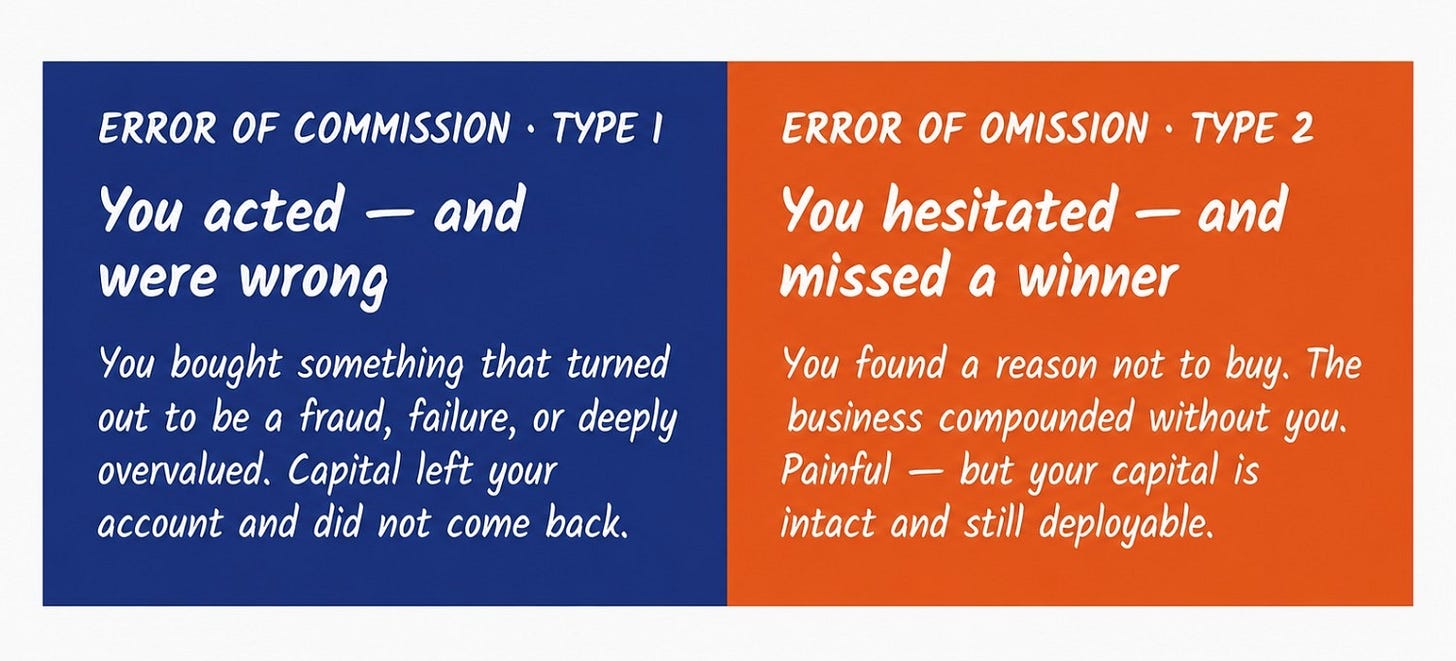
Both feel like mistakes. But they do not cost you the same way.
All Four Outcomes, Mapped Out
Every investment decision lands in one of these four boxes. The red cell is where most wealth is destroyed. The orange cell is where most regret lives. They are not equally dangerous.
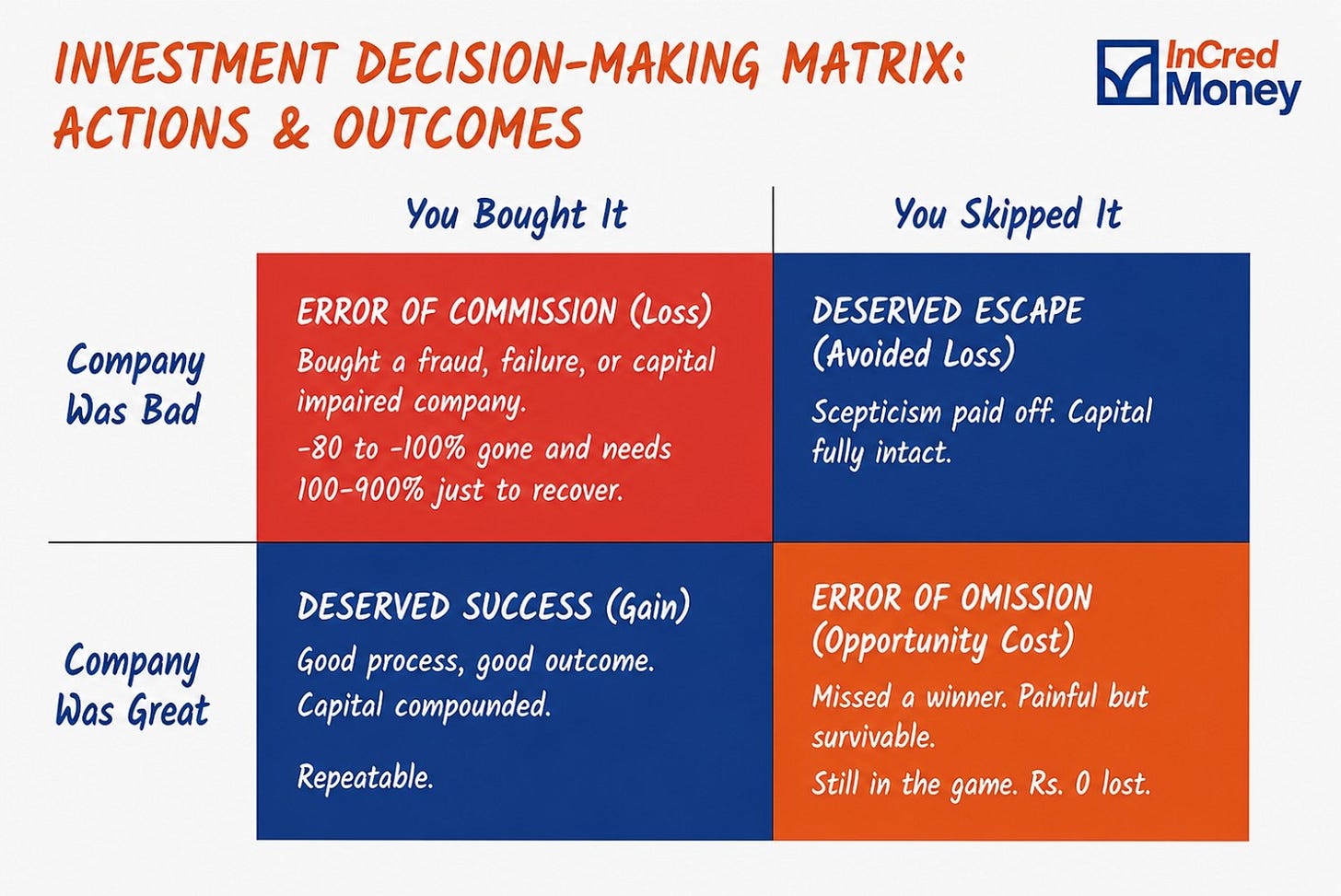
Notice the phrase in the omission cell: still in the game. Capital that wasn’t lost can be redeployed. Capital that was destroyed cannot.
Why Commission Errors Are Structurally More Damaging
The maths of recovery
A loss doesn’t just reduce your capital, it raises the return you need just to get back to zero.
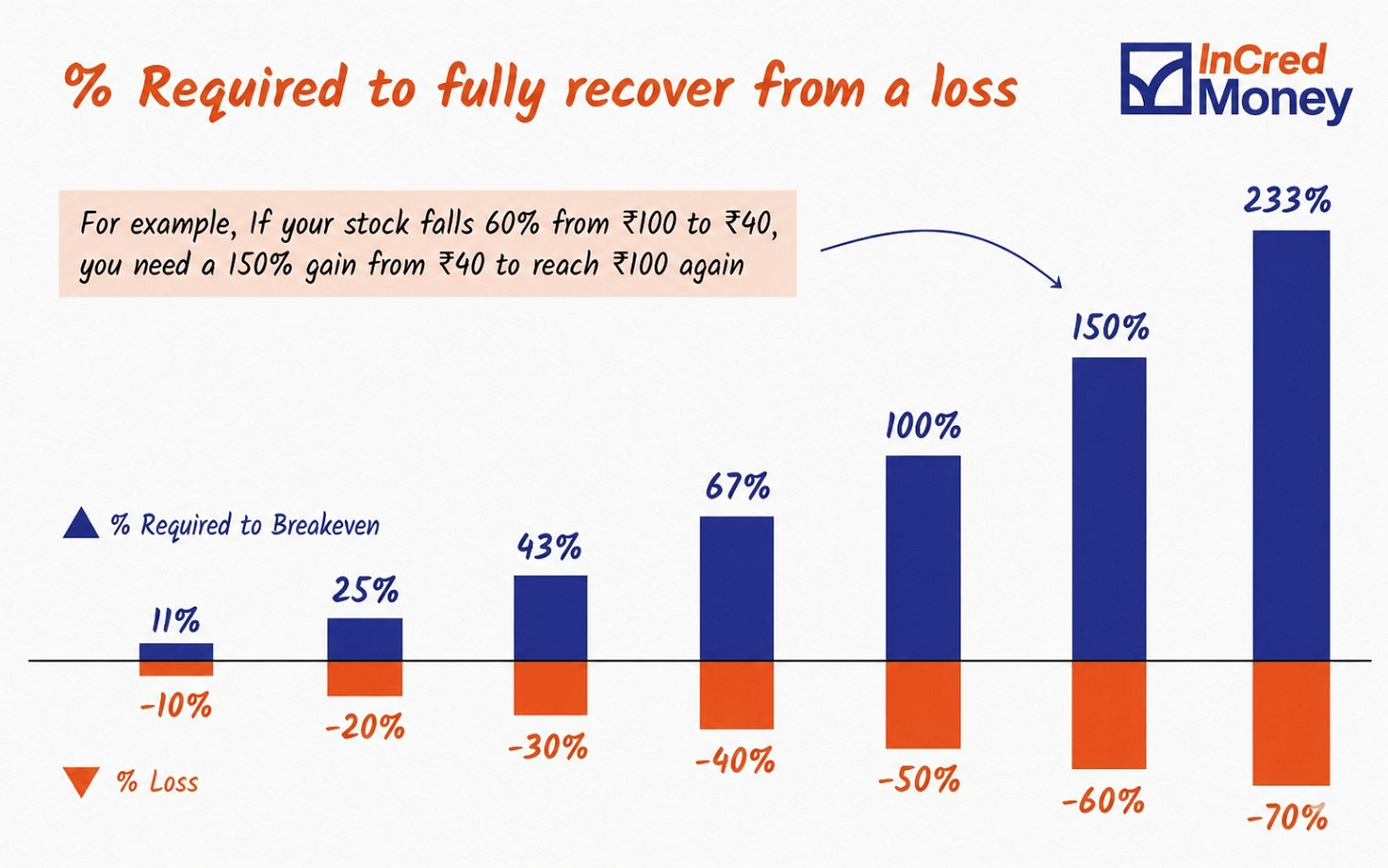
An error of omission, missing a stock that doubled, leaves your capital exactly where it was. You didn’t grow it, but you don’t have to climb a 233% mountain to get back to square one.
There’s A Second Problem: We’re Wired To Make It Worse
Think about the last time a stock in your portfolio fell 30%. What did you feel?
Most people don’t sell. They hold on and wait for it to “come back.” Now think about the last time a stock you owned went up 40%. How long before you booked profits?
If you’re honest, you probably sold the winner faster than the loser. Almost everyone does.
Psychologists call this loss aversion — losses feel about twice as painful as equivalent gains feel good. And it produces a very specific trap in investing: we end up holding our worst stocks too long and selling our best ones too soon.
So a single bad investment doesn’t just cost you the initial loss. It also keeps you locked into a falling stock while your good stocks quietly do well after you have exited them. One mistake, two ways to lose.
And these mistakes are psychologically damaging too
Let’s look at an example – Two investors. Same market. Same year.
Investor A buys Vakrangee in early 2018, chasing a five-year momentum story. Over the following months, the stock falls 80%. He loses ₹8 lakh on a ₹10 lakh position. Shaken, he steps away from markets for two years.
Investor B looks at Vakrangee at the same time but due to governance issues, decides to skip it. She misses the initial 30% run-up before the crash. She feels stupid for about three weeks.
A year later, Investor B continues investing but Investor A steps away for sometime still trying to recover financially and emotionally.
Buffett Said It First, And Simplest
“Rule No. 1: Never lose money.
Rule No. 2: Never forget Rule No. 1.”
— Warren Buffett
Notice what the rule doesn’t say. It doesn’t say never miss a winner. It doesn’t say always be fully invested. The entire emphasis is on the floor.
Berkshire’s record is built on almost zero catastrophic commission errors. Buffett and Munger passed on hundreds of ideas every year. They missed Walmart, Amazon, Google and many others.
But they could afford it as they didn’t have to worry about failed investments and always had some other opportunity to evaluate.
If You Miss Something, You Always Have Options
This is what makes errors of omission survivable in a way errors of commission are not. When your capital is intact, the game is still open.
1. The stock may correct and give you a second entry.
2. You can deploy the capital elsewhere.
3. You can research better, learn and then invest.
An error of omission is a tax on being too cautious. An error of commission can be a tax on being in markets at all.
Be Sceptical while Investing
Here’s some perspective on just how hard stock picking is: A 2018 academic study found that since 1926, just 4% of US stocks were responsible for all the wealth created in the entire US stock market. (Source: Bessembinder, Journal of Financial Economics, 2018)
What this means in plain terms: most stocks you will ever look at are not worth buying. And that is why it’s important that you look (carefully) before you leap.
Before you commit to an investment, take a pause and ask if you’re being impulsive. Go through your investing checklist before making a decision.
If you want to invest and are not sure which stock to invest, just buy an index ETF or a diversified mutual fund. Participating in the market without making a concentrated bet is always better than sitting out entirely.
The Takeaway
An error of omission leaves you in the game but an error of commission might not.
Missing a great stock is painful but recoverable and leaves your decision-making intact. Losing capital to a fraud or failure is painful but often irreversible, and, thanks to loss aversion, tends to produce further bad decisions.
The goal isn’t to be the investor who never misses a winner. It’s to be the investor who is still investing 20 years from now. Protect the floor first and then aim for the ceiling.
If you enjoyed this newsletter, feel free to share it with your friends and family using the link below.
Till the next time,
Vijay
CEO – InCred Money
P.S. I share my thoughts on Investing and the Economy regularly. You can follow me here.