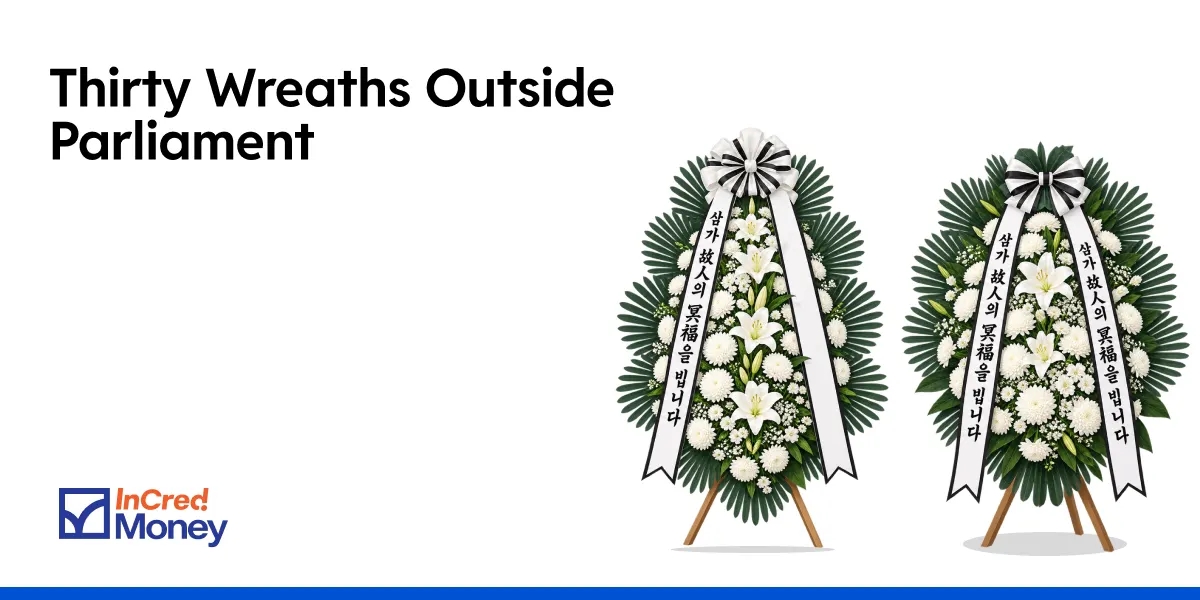
On the morning of 29th July, the pavement outside South Korea’s National Assembly in Seoul was lined with more than thirty white funeral wreaths.

Nobody had died. A group of retail investors had sent them, and the ribbons carried messages instead of names. One asked whether investor protection was just an illusion. Another wanted single-stock leveraged ETFs delisted immediately. A third said the market was slaughtering small investors.
Inside the building, on the same day, Korea’s finance minister apologised to lawmakers. The government hadn’t thought carefully enough about how these leveraged products would behave once they were out in the world, he said. The chairman of the financial regulator apologised separately.
The odd part is that nothing had gone wrong with Korean businesses. SK Hynix (a top memory chip maker) had just posted the best quarter in its history, with operating profit up 557% from a year earlier. Samsung was another top memory chip maker that the whole world wanted a piece of.
The problem wasn’t in what the Korean investors had invested in but when and in what they had invested.
How Korea got here
The Kospi has been the hottest index in the world. It crossed 8,000 on 26th May, took 16 trading days to get past 9,000, and made an all-time high of 9,385 on 19th June.
Korean investors didn’t just buy into that rally, they borrowed for a piece of it. Money borrowed from brokers to buy shares went from ₩27.4 trillion in January, about $19 billion, to a record ₩38.6 trillion by 24th June, about $27 billion. Nearly all of it was pointed at Samsung and SK Hynix, two stocks that between them made up roughly 50% of the index.
Just before hitting the top, a new product showed up. On 27th May, sixteen single-stock leveraged and inverse ETFs listed on the Korea Exchange, every one of them tracking Samsung or SK Hynix.
They were easy to like. No derivatives account required, no margin call, and no expiry date. Just a stock in the app you already had, promising twice the move of the stock everyone already wanted. In two months, Korean retail investors put a net ₩14 trillion into them, close to $9.5 billion.
How these Single Stock leveraged ETFs work
These funds promise twice the daily move of the stock. To do that, the fund resets its position at the close of every trading day. Over one day, it does exactly what it says. Hold it longer and the maths starts working against you.

The stock ends up exactly where it started. The fund doesn’t. Nothing has broken here; this is the product doing what it was built to do.
These ETFs are meant to be held for a day but in Korea they were sold to people as long term investments.
There is another nuance that affects the whole market. To maintain the 2x promise, the fund must rebalance its position daily. Since gains and losses only affect the investors’ portion while the borrowed amount stays fixed, the leverage ratio drifts and the fund is forced to rebalance every single day.

So the fund buys high and sells low, once a day, every day, regardless of what anybody thinks the company is worth. This is harmless while the fund is small but once these funds got big, and all of them were pointed at two stocks that were half the index, the whole market began moving faster in both directions. On the way up, that feels like a great bull run. On the way down it turns into a stampede, because a margin call doesn’t wait for you to be right some time in the future.
What it cost
The Kospi fell about 40% from its June high, wiping out more than $2 trillion of value. Citi estimates that Korean retail investors lost around $38.7 billion on leveraged Korean asset based ETFs (these losses include every leveraged ETF built on Korean assets, not just the new single-stock ones introduced in May) in a single month.

From the day the SK Hynix leveraged ETF was launched, while SK Hynix is around 32% lower, the ETF is 74% lower!
The recovery is where it really stings. For the stock to get back to its June high, it has to rise around 110%. For the leveraged fund, around 470%. And that’s assuming you were never sold out on the way down, which plenty of people were.
Korean regulators have since pushed the cash requirement up to ₩30 million (around $21,000) for individuals to trade the products, stopped new listings and banned advertising.
We have leverage in India too
We do have products like Futures and options (F&O), and margin trading facility (MTF), where the broker lends you money to buy shares. The MTF book crossed ₹1.4 lakh crore this month, the highest it has ever been. And SEBI has been saying for years, that most individual F&O traders end up losing money.
But here’s the bit worth appreciating. India has had leveraged products for decades, and not once have they taken the market down with them.
That isn’t luck. Leveraged and inverse ETFs aren’t permitted here at all. MTF works only on a defined list of stocks. Derivatives come with position limits, upfront margins and daily settlement through a clearing corporation. Lot sizes were raised and weekly expiries trimmed when retail activity got too hot. SEBI proposed another set of exposure caps for brokers in June.
Each of those rules causes somebody a bit of inconvenience, and together they’re why an individual can get leverage wrong here without the rest of us paying for it.
What hasn’t happened in India is one crowded leveraged trade dragging the whole market down, and that’s a genuinely good thing about how our market is put together.
Leverage is not the problem, but how its used is
Every bank on earth is leveraged by design. Every large company carries debt. The home loan most households take is four to five times their own savings, and we rightly call it one of the most sensible decisions a family can make. Leverage was never the villain here.
Leverage doesn’t change whether you were right. It just changes how much you get paid for being right, and how much you have to pay if you’re wrong.
A weapon in the hands of someone who doesn’t know how to use it usually ends badly, and that is one person’s problem. When most of a market is holding the same weapon and pointing it the same way, it becomes a systemic issue. That’s what those wreaths outside the National Assembly were really about.
Regulation can look after the system but it can’t size your position for you. So if you’re going to borrow, four questions are worth answering honestly.
- Are you borrowing out of conviction, or because you feel late?
- Do you know what the product does while you’re not watching it?
- How far can it fall before somebody else decides to sell it for you (margin call)?
- And what does the borrowing cost you every single day you hold it (interest cost)?
Get these wrong and. It only needs to take its time.
For individuals, the moral of the story: Bite only as much as you can chew.
If you enjoyed this newsletter, feel free to share it with your friends and family using the link below.
Vijay
CEO – InCred Money
P.S. I share my thoughts on Investing and the Economy regularly. You can follow me here.