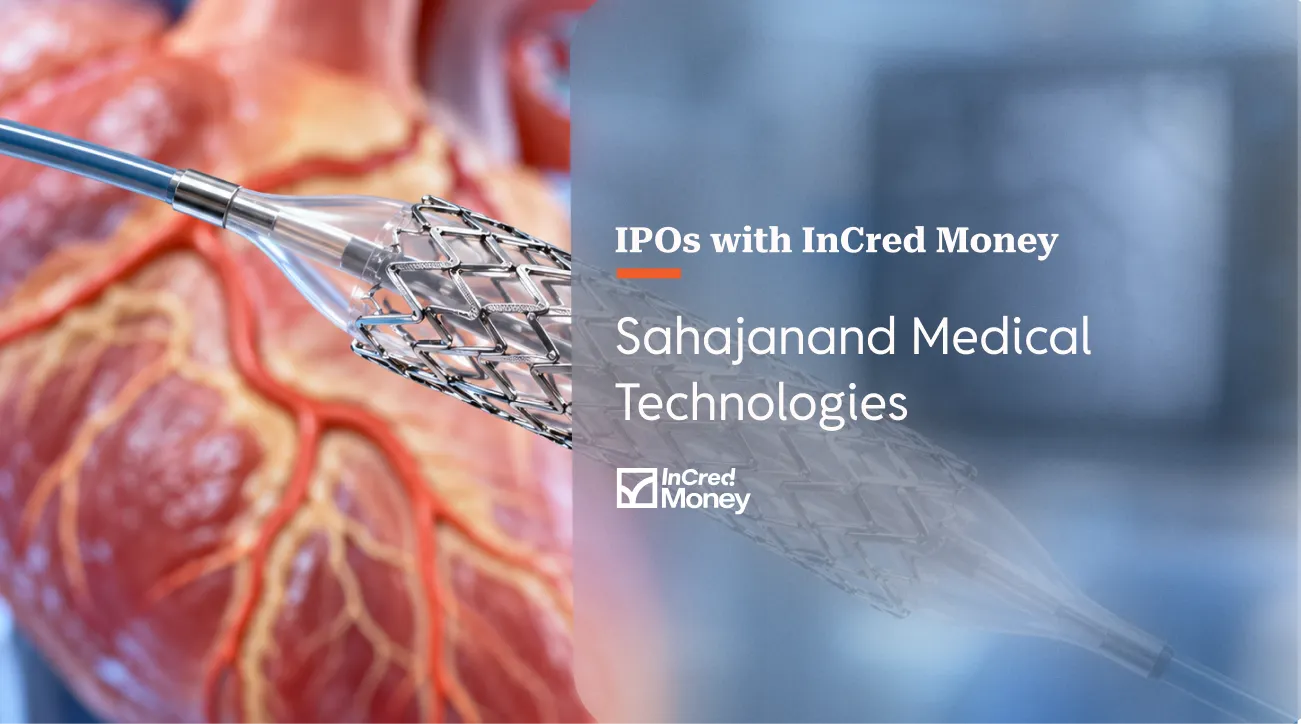
Sahajanand Medical Technologies Limited is going live for an IPO. It makes heart stents, valves and occluders at plants in Surat, Hyderabad and Thailand, and it sells nearly one in four drug-eluting stents bought in India, yet about three-fourths of its revenue now comes from outside India.
IPO Summary
| SMT IPO Details | |
|---|---|
| IPO Date | 15th to 19th Oct, 2026 |
| Sale Type | 100% OFS |
| Tentative Listing Date | 23rd Oct, 2026 |
| Price Band | ₹327 to ₹344 |
| Post Issue M-Cap at ₹344 | ₹3,496 Cr |
| Total Issue Size | ₹475 Cr |
Table: InCred Money • Source: Sahajanand Medical Technologies RHP
Introduction
Sahajanand Medical Technologies Limited (SMT) makes devices in both segments: Drug-Eluting Stents (DES) & Structural heart devices.
Nearly one in four DES sold in India in FY26 came from SMT.
A Drug-Eluting Stent (DES) is a small metal mesh tube, coated with a drug, that doctors place inside a blocked heart artery to hold it open. Yet India only brings that company only 26% of its revenue.
- The global DES market was worth about USD 4.30 Bn in 2025 and is expected to grow ~6.5% a year to USD 5.90 Bn by 2030.
- India’s DES market is smaller, at USD 205 Mn in 2025, but it is expected to grow fastest by volume, from 0.91 Mn stents in 2025 to 1.54 Mn by 2030, or ~11% a year.
Structural heart devices, which repair heart valves and close holes in the heart without open surgery.
- They form a larger global market of USD 12.1 Bn in 2025.
- In India, this segment was worth USD 53 Mn in 2025 and is expected to grow ~23% a year to 2030.
The Business Model
SMT was founded by Dhirajlal Kotadia in 2001. In 2005, it became the first company in the world to receive CE certification for a DES with a biodegradable polymer. It now sells its products in 77 countries and holds a market share of nearly 25% of DES sold in India by volume.
SMT sells three groups of products:
• Vascular Intervention (VI): coronary stents, balloon catheters used to open blocked arteries, and Sironity, a drug-coated balloon approved in India in 2025. The flagship product is the Supraflex Cruz DES. VI contributed 61.1% of revenue in FY26, down from 68.5% in FY24.

• Structural Heart (SH): Hydra, a TAVI valve that replaces a narrowed aortic valve through a catheter, and Cocoon occluders, which close holes in the heart. SH contributed 16.7% of revenue in FY26, up from 12.26% in FY24.
• Others: SMT’s own renal stent and peripheral drug-coated balloon, plus traded goods. This segment contributed 22.1% of revenue in FY26.
It sells directly in six European countries, including Germany, Spain, France and the UK.
It uses a hybrid model, mixing its own sales team with local distributors, in 20 countries including India, Brazil and Mexico. It relies fully on distributors in 39 countries.
Unit Economics (₹ per Device Produced)
A device here means a stent, TAVI valve, occluder or drug-coated balloon made during the year.

- Revenue per device rose 26%, from ₹13,268 in FY24 to ₹16,761 in FY26, while the number of devices produced rose only 6%.
- Material costs stayed between 24% and 26% of revenue in all three years, so they rose in step with revenue per device.
- Other expenses, mainly professional fees, conferences, travel and clinical trials, fell from 34.6% of revenue in FY25 to 32.6% in FY26. This explains most of the rise in Adj. EBITDA per device, which grew 50% over two years to ₹2,459.
Operating Metrics
- Structural Heart revenue nearly doubled in two years, growing 42.31% in FY25 and 29.08% in FY26. VI revenue grew ~9% a year over the same period, so the business is slowly moving away from stents.

- International revenue grew at a CAGR of 23.34%, from ₹588 Cr in FY24 to ₹894 Cr in FY26, and made up 76.16% of revenue in Q1 FY27. Europe overtook India in FY25 and became SMT’s largest region in FY26.

- SMT added 21 countries in two years. TAVI and occluders, the products that drive SH growth, are now sold in 35 and 50 countries, up from 21 and 33.

The Financial Stuff

- Revenue from operations grew at ~16% a year, from ₹902 Cr in FY24 to ₹1,211 Cr in FY26. Europe led the growth, with revenue there rising 27% in FY25 and 39% in FY26, while revenue from India fell 1.36% in FY26.
- Tax explains most of the swings in profit. The FY24 loss came after a ₹29 Cr charge for tax relating to earlier years. In FY26, a ₹9 Cr reversal of earlier-year tax provisions lowered the tax bill.
Sahajanand’s Peers (FY26)

- SMT is the second largest of the three by revenue, at about 65% the size of Poly Medicure and 4.4 times the size of Laxmi Dental.
- SMT has the PAT margin of about half of Laxmi Dental’s and about a third of Poly Medicure’s.
- SMT also trails behind both peers on RoE and RoCE.
- Neither peer makes cardiac devices. Poly Medicure earns most of its revenue from infusion therapy and renal products, while Laxmi Dental earns most of its revenue from dental laboratory products and aligners.
Key Risks
- One product carries the business: Supraflex Cruz made up 37.17% of FY26 revenue. Trademark oppositions have been filed against the “Supraflex” name, and the product faces competition from both Indian and global stent makers.
- Price caps in India: All of SMT’s DES fall under government price ceilings, so the company cannot raise prices in India when its costs rise. The NPPA may also extend price caps to other devices, or cap trade margins instead.
- EU certification deadline: Only Supraflex Cruz holds certificates under the new EU Medical Device Regulation. Pipit, Hydra and Cocoon rely on older certificates that allow sales in the EU only until 31st Dec, 2027. Europe made up 38.66% of FY26 revenue.
- Regulatory setbacks abroad: Regulators in Taiwan (2018) and Australia (2024) rejected applications for Hydra TAVI and asked for more tests or clinical studies. SMT also dropped its attempt to enter the US with Supraflex Cruz after spending ₹6 Cr across FY24 and FY25, citing falling stent prices there and the investment needed.
- Imported inputs and currency: 77.18% of FY26 purchases were imported, and the top 10 suppliers made up 59.15% of purchases, with a single supplier for some components. At the same time, 73.87% of revenue came from outside India, so rupee movements affect both costs and sales.
- Rising debt: Net debt rose from ₹95 Cr in FY24 to ₹238 Cr by June 2026. Working capital loans of ₹241 Cr, which include facilities repayable on demand, were outstanding at that date. Subsidiaries breached loan covenants in FY24 and FY26, and both breaches were waived by lenders.
- Collections: Bad debts written off rose from ₹0.6 Cr in FY24 to₹19 Cr in FY26. SMT has filed criminal proceedings against some customers and distributors over payment defaults.
IPO FAQs
Q: What is Sahajanand’s price band?
A: Sahajanand has a price band of ₹327 to ₹344
Q: What is Sahajanand’s closing date?
A: Sahajanand IPO closes on 19th Oct, 2026
Q: What is Sahajanand’s listing date?
A: Sahajanand lists on 23rd Oct, 2026, on the NSE and the BSE
Summary
SMT holds nearly a quarter of India’s DES market by volume, but its growth now comes from Europe and from its structural heart products, while sales of its flagship stent have barely moved.
Its FY26 EBITDA margin of 14.1% remains below both listed peers, and net debt has more than doubled since FY24. The IPO is a pure Offer for Sale, so the company will receive none of the money raised.