SFC Environmental Technologies Limited is going live for an IPO. Their waste management technology runs in a lot of sewage plants. They design and supply the equipment that EPC contractors install in city sewage and waste plants.
IPO Summary
| SFC Environmental IPO Details | |
|---|---|
| IPO Date | 27th to 29th Oct, 2026 |
| Issue Type | Fresh Issue + OFS |
| Tentative Listing Date | 3rd Nov, 2026 |
| Price Band | ₹313 to ₹330 |
| Post Issue Mcap at ₹330 | ₹3,233 Cr |
| Total Issue Size | ₹668 Cr |
Introduction
India’s cities generated an estimated 90,061 million litres per day (MLD) of sewage in FY26. Treatment capacity was an estimated 52,436 MLD.
That leaves about 42% of urban sewage untreated.
The Indian sewage treatment market grew 5.4% a year from FY20 to FY25, and is projected to grow ~10% a year from FY25 to FY30.
One common way to treat sewage is a sequencing batch reactor (SBR), which cleans sewage in batches inside a single tank.
SBR plants make up ~30% of India’s installed treatment capacity.
SFC Environmental Technologies Limited (SFC) holds over 80% of India’s SBR market
SFC is coming to market with an IPO consisting of a Fresh Issue of ₹150 Cr and an Offer for Sale of ₹518 Cr, from 27th to 29th Oct, 2026.
The Business Model
SFC was incorporated in Mumbai in 2005. SFC sells technology, design and equipment to treat sewage and solid waste. Technology developed by SFC has treated ~17,511 MLD of wastewater as on Jul 31, 2026
The company works in three segments: wastewater treatment (WWT), wastewater recycling and reuse (WRR) and solid waste treatment (SWT). A fourth segment, Automation, is its subsidiary Chavare Engineering, which makes control panels and automation systems.
Wastewater treatment (WWT): SFC’s own SBR technology is called C-Tech. It removes up to 98% of biochemical oxygen demand in a single step. Power makes up almost 80% of the cost of running a sewage plant, though compared with conventional technologies, it uses up to 40% less power and up to 50% less land.
A WWT order works like this:
- A city or local body invites bids from EPC contractors to build a sewage plant.
- SFC works with these contractors before they bid. It gives them technical support and cost estimates, so that C-Tech is part of their bid.
- When a contractor wins, SFC designs the plant, makes or buys the key equipment, and delivers it over six to 12 months, supervising installation and commissioning.
- SFC also sells spares to the contractors who run the plants.
SFC makes much of its own equipment. It makes decanters near Pune, diffusers at Satara through Fine Aeration Systems, turbo blowers at Dombivli through its associate Turbomax India, etc.
In July 2025, it bought 80% of IST-Anlagenbau GmbH, a German maker of solar sludge dryers.
Wastewater recycling and reuse (WRR): WRR means treating sewage a second time so that industry can reuse the water. SFC has an exclusive agreement with DuPont to distribute its ultrafiltration membranes, closed circuit reverse osmosis systems and membrane bioreactor modules in India’s municipal market.
Solid waste treatment (SWT): SFC’s own SWT technology is called OREX. It separates organic waste from mixed city waste, so the organic part can be turned into biogas.
SFC built and runs two waste plants in Goa for the Goa Waste Management Corporation, with a combined capacity of 350 tons per day (TPD), and can handle up to 425 TPD.
These plants earn from tipping fees, an annual operation support grant (North Goa), sale of electricity from biogas, and sale of recyclables, compost and scrap.

Unit Economics (per ₹100 of Revenue)

- Cost of goods sold fell from ₹47 to ₹41 per ₹100 of revenue between FY24 and FY26.
- Project cost, which is the cost of building and running the SWT plants, rose from ₹4 in FY25 to ₹9 in FY26, as work began on the CBG plants.
- Employee cost rose from ₹9 in FY24 to ₹11 in FY25 and FY26. Other expenses stayed ~₹10.
- The fall in goods cost was mostly absorbed by the higher project and employee costs, thus Adj. EBITDA stayed between ₹29 and ₹30 per ₹100 of revenue.
Operating Metrics
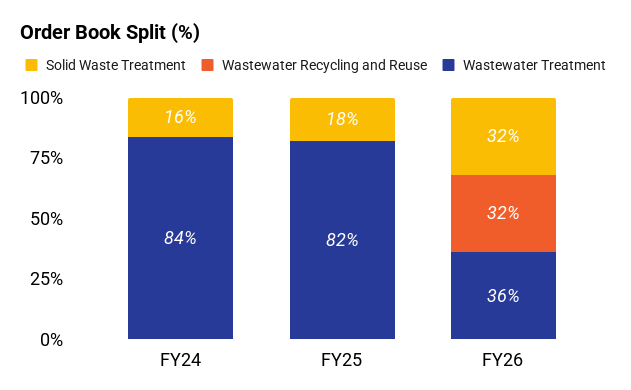
- WWT’s share of the order book fell from about 84% in FY24 to 36% in FY26. SWT (₹503 Cr, mainly the CBG orders) and the new WRR segment (₹501 Cr) now make up nearly two-thirds of the FY26 order book.
- SWT revenue grew 2.8x from ₹50 Cr in FY24 to ₹140 Cr in FY26, after the South Goa plant began operating in May 2023 and work started on the CBG plants. Its share of total revenue in fact rose from 8% to 17%.


- Most WWT revenue comes in the second half of the year, with the share rising to 86% in FY26. This is mostly due to the timing of government budget releases and the monsoon slowing work in the first half.

The Financial Stuff

- Revenue grew from ₹658 Cr in FY24 to ₹804 Cr in FY26, a CAGR of ~11%.
- Adj. EBITDA Margin stayed between 29% to 30% across the three years.
- PAT grew at a CAGR of ~5%, slower than revenue. PAT Margin fell from 22% to 20%.
- Depreciation more than doubled from ₹13 Cr to ₹28 Cr, Finance Costs rose from ₹9 Cr to ₹15 Cr.
SFC’s Peers (FY26)

- SFC has the smallest revenue of the four, at ₹804 Cr. Thermax is the largest at ₹10,694 Cr.
- SFC’s PAT margin of 20% is the highest among the peer group, with Thermax being the closest at 7%.
- SFC’s ROE of 21.6% and ROCE of 22.2% are also the highest of the four.
At the upper band of ₹330 and FY26 diluted EPS of ₹16.52, SFC will trade at a P/E of 20.0x. Peers include 44.4x at Ion Exchange, 91.3x at Praj, among others.
Key Risks
- Government dependence: Projects funded or awarded by government bodies gave 92% of FY26 WWT revenue and 100% of SWT revenue. Changes in budgets, policy or tender timing can delay orders and payments.
- Seasonality: 86% of standalone WWT revenue came in the second half of FY26. A weak second half can hurt the full year. In Q1FY27, PAT was ₹1.5 Cr and the WWT margin was just 0.4%.
- Technology and market: SBR makes up about 28% to 30% of India’s installed treatment capacity. If SBR adoption does not rise, or newer technology replaces it, SFC’s growth may suffer.
- SWT capital needs and concessions: SWT contracts have required an equity investment of up to 25% of project cost, repaid over several years, and bank guarantees of up to 10%. The North Goa concession runs only until August 20, 2027, and neither Goa concession renews automatically.
- New WRR segment: SFC has no operating track record in WRR. DuPont can end the exclusive supply agreement if SFC does not meet minimum purchase quantities.
- Legal proceedings: Cases against subsidiaries involve ~₹69 Cr. These include a suit by a Portuguese municipality against Austrian subsidiary SFC Umwelttechnik GmbH seeking about €5.6 Mn (~₹60 Cr) over a sewage plant. The Goa plants have received show cause notices over waste handling.
- Governance: SFC Umwelttechnik GmbH was on the World Bank’s debarred list from November 2016 to February 2018 after fraudulent practices were found in two Vietnam projects.
IPO FAQs
Q: What is SFC’s price band?
A: SFC has a price band of ₹313 to ₹330
Q: What is SFC’s closing date?
A: SFC IPO closes on 29th Oct, 2026
Q: What is SFC’s listing date?
A: SFC lists on 3rd Nov, 2026, on the NSE and the BSE
Summary
SFC supplies the technology inside over 80% of India’s SBR sewage plants and has held its Adj. EBITDA margin near 29% for three years. Its order book of ₹1,657 Cr on August 31, 2026 was 2.1x FY26 revenue, helped by the new orders. But PAT grew slower than revenue, and ~92% of WWT revenue depends on government-funded projects.