Imagine winning a massive lottery jackpot tomorrow. Millions of dollars land in your bank account (after taxes, assuming today’s Union Budget is kind). You quit your job, buy a mansion, and start spending lavishly.
At first, it feels like a dream. But soon, your skills get rusty because you aren’t working. Your old friends drift away because they can’t relate to your new lifestyle. You rely entirely on that pile of cash. If that money suddenly runs out or loses value, you are left with no job, no skills, and a lifestyle you can no longer afford.
Believe it or not, entire countries go through this exact same problem. It’s a phenomenon economists call Dutch Disease.
Venezuela’s economic crisis, despite its great natural resources, prompted me to explore this further and this is how I stumbled upon this interesting topic.
Why is it called “Dutch Disease”?
It sounds like a medical condition, but it is actually an economic one.
The term was coined in 1977 by The Economist magazine to describe what happened to the Netherlands in the 1960s. The Dutch discovered a massive natural gas field in the North Sea. It seemed like a blessing! They exported the gas and money flooded in.
However, as they sold gas to the world, the value of their currency skyrocketed. This made their other products, like manufacturing and agriculture, too expensive for other countries to buy. Factories closed, unemployment rose, and the economy actually got worse despite the new wealth. The “blessing” had become a curse.
Why Do Countries Fall Into This Trap?
It happens because of a sudden imbalance. When a country finds a huge resource (like oil, gold, or gas), two main things usually happen:
Currency Spike: Foreign countries rush to buy the resource, boosting the local currency’s value. This makes other exports (like cars or crops) very expensive and uncompetitive globally.
Laziness & Neglect: The government and businesses focus all their energy and money on that one “cash cow” resource. They stop investing in education, technology, or manufacturing.
Eventually, the country becomes a “one-trick pony.” If the price of that resource drops, the whole economy collapses because there is no backup plan.
The Victims: Countries That Got Trapped
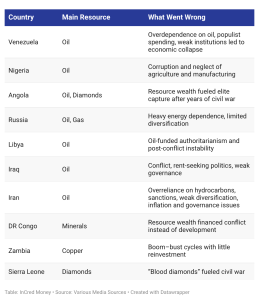
Many nations have struggled with this. Here is a look at a few notable examples:
The Survivors: Escaping the Trap
Is it possible to find treasure and not ruin your economy? Yes, but it requires incredible discipline.
Countries like Canada, Saudi Arabia, UAE, Norway and Botswana have managed their resources reasonably well. Even the Dutch got out of this trap sooner than later.
How Norway Did It
When Norway found oil, they knew about the Dutch Disease. They decided on a bold strategy: Don’t spend the money.
Instead of spending their oil profits on tax cuts or fancy projects, they put the money into a massive savings account called a Government petroleum fund, later known as the Government Pension Fund.
Investing Abroad: They invested this money in companies all over the world, not just in Norway. This kept their own currency stable.
Saving for the Future: They only spend the interest earned from the fund, not the fund itself.
Today, Norway’s pension fund is worth over $1.6 trillion. They turned a temporary resource into permanent wealth for their future generations.
Conclusion
Dutch Disease teaches us that having resources isn’t enough; you need to manage them wisely. It is the difference between the lottery winner who goes broke in five years and the one who invests the money to build a secure life. Wealth without work or diversification is often just a trap in disguise.
If you enjoyed this newsletter, feel free to share it with your friends and family using the link below.
Also, if you have any topics that you would like us to cover or any other feedback, do write to us at connect@incredmoney.com.
Till the next time,
Vijay
CEO – InCred Money
P.S. I share my thoughts on Investing and the Economy regularly. You can follow me here.