I’ve been following the Iran war story like everyone else. Oil prices, supply shocks, inflation headlines. But something else has been happening in the background unrelated to the war.
Jamie Dimon, CEO of JPMorgan, the man who has steered the world’s largest bank through every major crisis of the last two decades, said publicly that what he’s seeing in financial markets (specifically the private credit market) today reminds him of the years just before 2008.
So in this newsletter, we have covered what is really happening in the US private credit market and what it can mean for us.
Back to 2007-08
Before 2008, banks spent years lending aggressively. It packaged those loans into complex products, and sold them off to investors. Everyone assumed someone else had checked the risk. Meanwhile, oil surged from $20 in the early 2000s to over $130 a barrel in 2007-08.
It led to the following chain reaction: Rising Oil → Rising Inflation → Rising Rates → Borrowers Default → Imminent Crisis
Millions of people who had never heard the word “subprime” (a term for loans given to borrowers with weak credit histories) watched their savings halve.
And of course, it famously came to be known as the Subprime Mortgage Crisis which then turned into the Global Financial Crisis (GFC).
If you zoom out, the situation today has some similarities. Oil prices are rising because of the conflict in the Middle East, which is likely to push inflation higher. The US Federal Reserve (America’s central bank, equivalent to our RBI) may raise interest rates in response.
And once again, credit has expanded rapidly, but not inside regulated banks this time. It has grown in something called private credit.
What is Private Credit?
After the 2008 crisis, banking regulators around the world introduced stricter rules. This led to US Banks pulling back from lending to smaller, mid-sized businesses, which were seen as riskier.
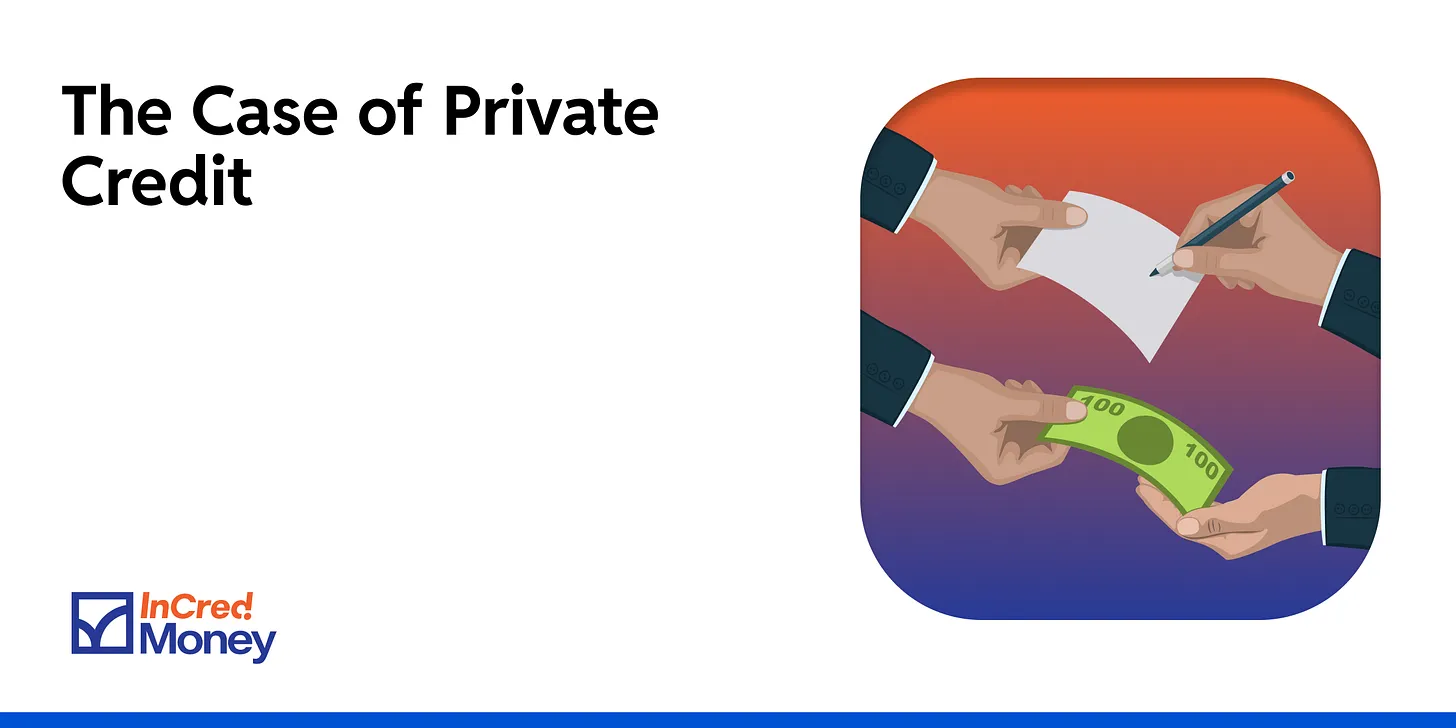
That gap created an opportunity for a new class of lender: Private Credit Funds. These are investment funds run by large asset management firms, not banks, that raise money from big institutional investors (like pension funds, insurance companies, and family offices) and lend it directly to mid-sized businesses. Because they are not banks, they are not subject to the same regulations.
Here is an infographic explaining how Private Credit Works

For investors who put money into these funds, the returns looked very attractive, typically between 12-18% per year. The loans were also structured as senior secured debt, meaning in the event a borrower defaults (fails to repay), the lender has first claim on the company’s assets before anyone else gets paid. Over fifteen years, the private credit market grew from roughly $300 billion to nearly $1.8 trillion.

Who Did They Lend To?
A large portion of private credit flowed into software companies, particularly the SaaS (Software-as-a-Service) segment. Think of companies whose products you access online on a subscription basis, like project management tools, accounting software, or HR platforms.
And on paper, these looked like ideal borrowers. SaaS businesses have predictable subscription revenue, high customer retention (switching to a competitor is painful), and healthy profit margins. So private credit piled in. Lending to SaaS companies alone grew over 60 times in a decade, reaching $500 billion by the end of 2025.
Private Credit lent either directly to these software companies or to large investors (Private Equity players) who bought out these software companies. As competition heated up among private credit funds to deploy their capital, lending standards slipped. Loans got bigger, covenants (the conditions borrowers must maintain) got looser, and companies that might not have qualified earlier started getting funded.
The Crack Nobody Saw Coming
AI changed the equation for software companies completely.
Software businesses built their value on humans needing their products to do tasks be it coding, workflow automation, data processing and a lot more. When AI tools started doing those tasks itself, the business model of hundreds of these companies became fragile overnight.
The actual panic began in late January and early February when the new agentic AI tools were launched by Anthrophic. If AI could do most of the work that software firms were charging for, what happens to the revenue of those firms? And if the revenue dries up, can they repay their loans?
Once that uncertainty set in, investors who had put money into private credit funds started rushing to withdraw their investments.
Many of these funds had promised quarterly withdrawals. When fear hit, everyone tried to leave at once. The funds couldn’t sell their underlying loans fast enough. So they did the only thing they could. They capped withdrawals.

Is This Actually 2008?
Probably not. Private credit at under $2 trillion (5% of current US GDP) is far smaller than shadow banking before 2008, which had ballooned to over 200% of US GDP.
But here is the thing about finance. Everything is connected. A stress in one corner of the market rarely stays in that corner. It finds cracks, seeps through, and sometimes brings down walls that looked solid.
There is also another dimension to this. Private credit funds, which were once the exclusive preserve of pension funds and large institutions, have in recent years been sold to individual investors as well. The pitch was simple and compelling: high returns, low defaults, and a track record that looked near-pristine. Many retail investors, lured by these high yields, put significant savings into these products. If stress in the underlying loans deepens, it will not just be Wall Street firms taking the hit.
As the world tackles wars, high inflation, threat by AI, tariffs and so many other variables, the next few months would be a real test of time for these funds.
Let’s see how Private Credit passes this test.
If you enjoyed this newsletter, feel free to share it with your friends and family
Till the next time,
Vijay
CEO – InCred Money
P.S. I share my thoughts on Investing and the Economy regularly. You can follow me here.