March 2026. Semaglutide, the molecule behind Ozempic and Wegovy, the weight-loss drug, loses its patent protection in India this month which they kept for 20 years!
The legal wall that allowed one Danish company to charge ₹10,000–₹25,000 a month for a drug that costs roughly ₹1,500 to manufacture is coming down.
What follows could be one of the most consequential pharmaceutical events in the Indian healthcare history. To understand why, you need to know how we got here.
From Failure to a Trillion-Dollar Duopoly
For decades, the war on weight was mostly a story of failure and embarrassment. The only breakthrough came from an unexpected place: diabetes research. Scientists discovered a gut hormone called GLP-1 (Glucagon-Like Peptide-1), the signal your body sends after eating that says “enough now.” Novo Nordisk built a drug to mimic it.
Early versions of Semaglutide (one of the GLP-1 drugs), from around 2006, showed modest results, weight loss of just 3-5%. That time weight loss was just a side effect of diabetes treatment, so it never came into limelight for weight loss. It was only when doses were pushed higher through the trials between 2021 and 2023 that the results became extraordinary: 15-18% average weight loss.
Eli Lilly followed with Tirzepatide (another GLP-1 drug), targeting two gut hormones instead of one, pushing that number to 22.5%.
These two companies now control the entire GLP-1 market. Novo Nordisk’s Semaglutide which gets sold as Ozempic and Wegovy. Eli Lilly’s Tirzepatide which gets sold as Mounjaro and Zepbound. Gross margins of 80-85%. A combined market cap that crossed a trillion dollars at peak.
According to PwC, 8% to 10% of Americans are currently taking GLP-1s, while 30% to 35% of Americans are interested in using them. Demand for prescriptions has been so high that suppliers often struggle to meet demand.
India’s Missed Window, And Second Chance
In 2010, Zydus Lifesciences had quietly cracked something even Novo Nordisk was struggling with — an oral GLP-1 drug. Oral delivery is genuinely hard; these molecules tend to break down in the stomach before reaching the bloodstream. Zydus solved it, received Indian regulatory approval for phase 1 trials, and then shelved it.
Here’s What’s Going To Happen!
The cost of international trials was too steep. But with the patent now expiring, Indian pharma gets a second look. India can capitalise on this opportunity through big Indian pharma giants like Biocon, Sun Pharma, Cipla, Dr. Reddy’s, Lupin & Zydus are already preparing to manufacture generic versions of GLP-1 drugs post-patent expiry.
The economics are compelling. Generics typically carry margins of 80-90%, and for patients, the cost of the drug is expected to fall by nearly half, making it accessible to a population that has largely been priced out until now. Prices are likely to fall from 10,000 per month to around ₹3,000-3,500 per month.
The Second Order Effects
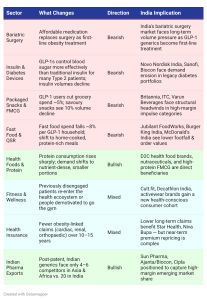
India has over 101 million diabetics, the second highest in the world. At ₹3,000-3,500 a month , GLP-1 stops being a luxury and starts becoming standard of care. And when a drug moves from elite to mass market, the ripple effects go well beyond the pharmacy shelf. Consider this a sector-by-sector impact map.
That being said, India has always been the world’s pharmacy for the developing world, making life-saving drugs accessible when Western pricing made them impossible.
But only if we play it strategically. China is already moving aggressively into GLP-1 generics, as both a low-cost API (API’s are the actual medicinal substance in a drug that makes it work) supplier and a direct competitor in Asia and Africa.
Indian companies that don’t build API independence will find themselves squeezed from both ends. The window is real, but it won’t stay open forever.
If you enjoyed this newsletter, feel free to share it with your friends and family!
Till the next time,
Vijay
CEO – InCred Money