
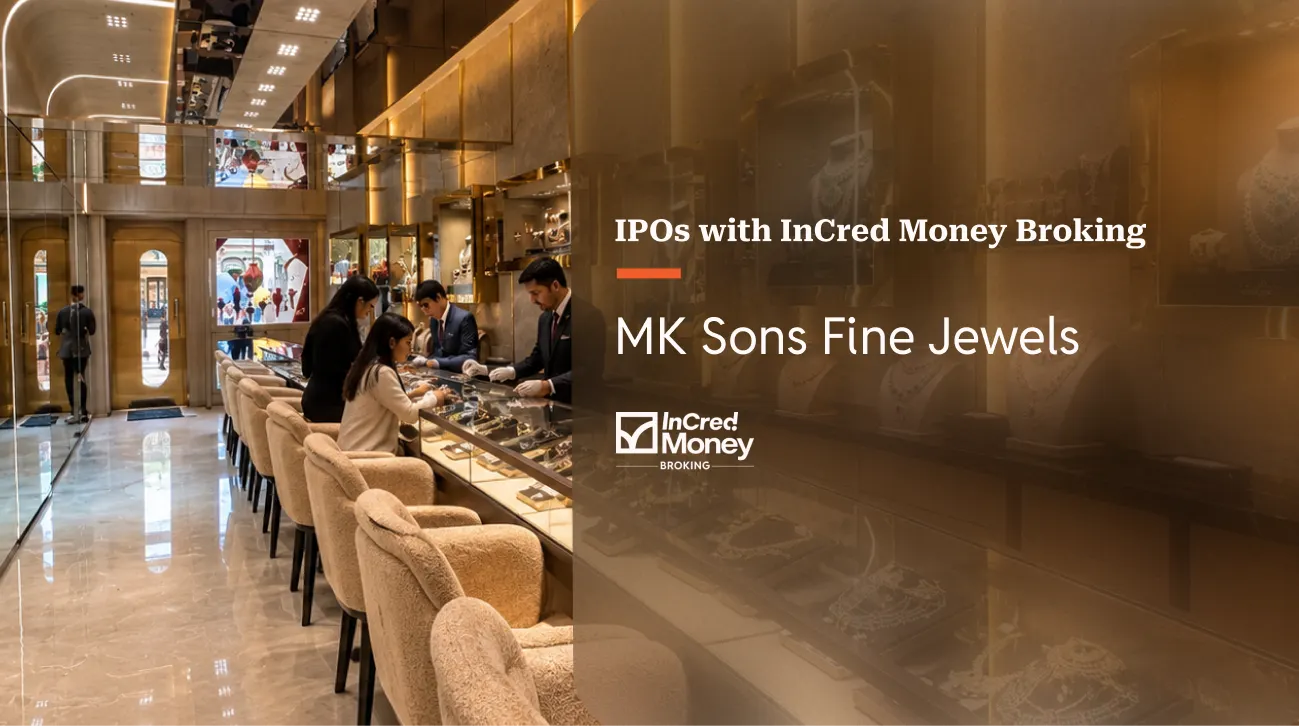
M. K. Sons Fine Jewels Limited is going live for an IPO. They sell gold and diamond jewellery through five showrooms in Mumbai and Ahmedabad.
IPO Summary
| MK Sons Fine Jewels IPO Details | |
|---|---|
| IPO Date | 28th to 30th Oct, 2026 |
| Issue Type | Fresh Issue + OFS |
| Tentative Listing Date | 4th Nov, 2026 |
| Price Band | ₹153 to ₹162 |
| Post Issue Mcap at ₹162 | ₹912 Cr |
| Total Issue Size | ₹275 Cr |
Introduction
India’s retail gold jewellery market was worth ₹5.73 lakh Cr in CY25. growing ~8.9% per year from CY20 and projected to reach ₹9.55 lakh Cr by CY30.
Higher gold prices, rising incomes and the move to branded, hallmarked jewellery drive this growth.
But, most of the market still sits with local jewellers. The unorganised segment held ~63% of the market in CY25 and organised retailers held the rest. Mandatory hallmarking of gold jewellery, in force since January 2021, and GST have reduced the cost edge local jewellers once had.
M. K. Sons Fine Jewels Limited (MK Jewels) is a Mumbai-based jewellery retailer with five showrooms in Mumbai and Ahmedabad. They’re coming to market with an IPO consisting of a Fresh Issue of ₹220 Cr and an Offer for Sale of ₹55 Cr, from 28th to 30th Oct, 2026.
The Business Model
MK Jewels is a retailer. It does not make jewellery. It buys finished pieces from manufacturers and wholesalers, mainly in Maharashtra and Gujarat, and sells them in its own showrooms.
It has worked with ~380 manufacturers and wholesalers and 9 karigars (artisans).
A 7-person in-house design team creates a small share of the range, which karigars then make. Karigars also modify some bought pieces.

It runs five showrooms: Bandra, Andheri and Zaveri Bazaar in Mumbai, and C.G. Road and Sindhu Bhavan Road in Ahmedabad.
Together they cover 6,513 sq ft. The company owns and runs all five on leased premises.
- Mumbai: Bandra and Zaveri Bazaar serve premium buyers. Bandra also houses Ra Ra Ru, an appointment-only lounge for bridal and high-value customers.
- Ahmedabad: C.G. Road and Sindhu Bhavan Road serve a wider base, including middle-income and value-conscious buyers.
All revenue comes from the showrooms. The company has no online sales, though it has over 591,000 Instagram followers. It took part in 16 exhibitions in FY26. Advertising spend was ~₹2 Cr in FY26.
The pricing goes from about ₹11,000 all the way up to ₹85 lakh. Gold jewellery gave 87% of FY26 revenue, colour stone jewellery 7% and diamond jewellery 6%.
Bracelets, rings, earrings, chains, and pendants are among the best selling categories.
New stock lands at the Bandra and C.G. Road showrooms and moves from there to the other stores in each city.
Unit Economics (₹ per Order)

- Revenue per order (AOV) rose from ₹1,39,767 in FY24 to ₹1,92,412 in FY26, up 38%, and is actually ₹2,15,416 as on Q1FY27.
- Cost of goods per order rose more slowly, by 23% from FY24 to FY26.
- Employee and other costs stayed between ₹4,500 and ₹6,500 per order from FY24 to FY26, so most of the gross profit gain has reached EBITDA.
- EBITDA per order in fact, rose from ₹8,300 in FY24 to ₹29,600 in FY26.
Operating Metrics
- Orders rose 80% from FY24 to FY26 and AOV rose 38%. In Q1 FY27, AOV rose again to ₹2,15,416 while gold per order fell to 10.93 grams, against 18.04 grams in FY26.

- Unique customers doubled from 12,042 in FY24 to 24,274 in FY26. About 9 in 10 FY26 customers were new. Returning customers were 9.6% of the FY26 base, down from 12.1% in FY25.

- Gold has stayed between 85% and 90% of revenue. Gold jewellery carries lower margins than diamond jewellery, yet the diamond share has not risen.

The Financial Stuff

- Revenue went from ₹217 Cr in FY24 to ₹351 Cr in FY25 and ₹539 Cr in FY26, a CAGR of 57%, with the same five showrooms.
- EBITDA Margin was 6% in FY24, 11% in FY25 and 15% in FY26.
- PAT went from ₹8 Cr to ₹52 Cr, with PAT Margin going from 4% to 10% in the same period.
- Depreciation rose from ₹1 Cr in FY25 to ₹4 Cr in FY26 as office equipment, furniture and leased premises (right-of-use assets) were added.
- Finance Costs also rose from ₹1 Cr in FY24 to ₹7 Cr in FY26 as borrowing for inventory grew.
MK Jewels’ Peers (FY26)

- MK Sons’ revenue of ₹539 Cr is close to Motisons’ ₹490 Cr and PNGS Reva’s ₹439 Cr. Senco is the largest at ₹8,430 Cr.
- MK Sons’ RoE of 31% is the highest in the peer set above even TBZ’s 24%.
- Inventory days of 193 are the lowest in FY26, but MS Sons is among the highest leveraged firms in the mix.
At an upper band of ₹162 and FY26 basic EPS of ₹12.13, MK Jewels will trade at a P/E of 13.4x. Peers include 8.76x at Senco, 26.0x at Motisons, among others.
Key Risks
- Limited showrooms, no online channel: The C.G. Road showroom gave 57% of FY26 revenue and 55% of Q1FY27 revenue. All sales happen in five showrooms, with no online channel to offset a fall in footfall.
- Gold prices: A fall in gold prices may cause inventory valuation losses. A rise increases working capital needs and interest costs, and may reduce demand. The RHP adds that higher realisations from price increases may not always translate into better margins.
- Supplier dependence: The company makes nothing itself and has no long-term supply contracts. The top 10 suppliers gave 47% of FY26 purchases, against 19% in FY24. The top supplier alone gave 15%.
- Few repeat buyers: Returning customers were 2,322 of 24,274 in FY26, or 10%. Revenue depends on finding new buyers each year.
- Legal and governance: Tax authorities treated ₹5 Cr of cash deposited during demonetisation as unexplained and raised a demand of ₹4.3 Cr, which the company has appealed. Income tax contingent liabilities stand at ₹5 Cr. The company paid ~₹4 Cr of GST late in FY24 and ₹1.4 Cr in FY25, and has delayed TDS payments in each period.
IPO FAQs
Q: What is MK Jewels’ price band?
A: MK Jewels has a price band of ₹153 to ₹162
Q: What is MK Jewels’ closing date?
A: MK Jewels IPO closes on 30th Oct, 2026
Q: What is MK Jewels’ listing date?
A: MK Jewels lists on 4th Nov, 2026, on the NSE and the BSE
Summary
MK Jewels grew revenue 57% a year from FY24 to FY26 with the same five showrooms, and EBITDA margin rose from 6% to 15%, reaching 23% in Q1FY27. But one showroom gives over half of revenue, inventory makes up 90% of assets, and inventory days are rising.