

Annu Projects Limited is going for an IPO of ₹175 Cr from August 25th to 28th, 2026. Annu Projects builds and maintains overhead and underground utility infrastructure, mainly telecom fibre networks and sewerage systems, and has laid over 62,800 km of optical fibre cable across India.
IPO Summary

Introduction
India is laying fibre, sewers, and gas pipes faster than at any point in its history. The government wants every village connected to broadband under BharatNet. Cities are building new sewage systems under the Namami Gange and Swachh Bharat missions. Gas utilities are extending city gas networks into smaller towns. All this work needs contractors who can dig, lay pipe, and hand over a finished project on time.
IPOs for such contractors are also on the rise this year. Annu Projects Limited is one such contractor.
Founded in 2003 and based in Delhi, the company has laid and maintained more than 62,800 km of optical fibre cable, built sewerage infrastructure across five states, and installed gas pipelines for four state gas utilities.
They’re now going live in an IPO consisting entirely of a Fresh Issue of ~₹175 Cr, from 25th to 28th Aug, 2026.
The Business Model
Annu Projects builds and maintains underground and overhead infrastructure for four business verticals:
- telecom infrastructure (laying and maintaining optical fibre cable networks),
- sewerage infrastructure (pipe laying, treatment plants, pumping stations),
- gas pipelines (laying MDPE pipe and setting up household gas connections), and
- railway signalling, which they entered for the first time in FY26.
The company wins work in two ways. Most projects come through competitive bidding run by central or state government bodies. Some come on as sub-contracting to private companies executing larger government-funded schemes.
In fact, government customers, directly or through sub-contracts, account for ~57 % of revenue.
Once Annu wins a contract, it does not lease equipment to build it. The company owns 558 machines, including excavators, horizontal directional drilling rigs, and fibre-splicing equipment. This cuts equipment rental costs and gives the company control over project timelines.
Revenue is recognised as the company completes stages of work. The unexecuted value of a signed contract sits in the order book until billed. This makes The order book value is recognized as revenue only upon the completion of the project, or a particular stage of a project. Thus the order book acts as a clear indicator of future revenue.
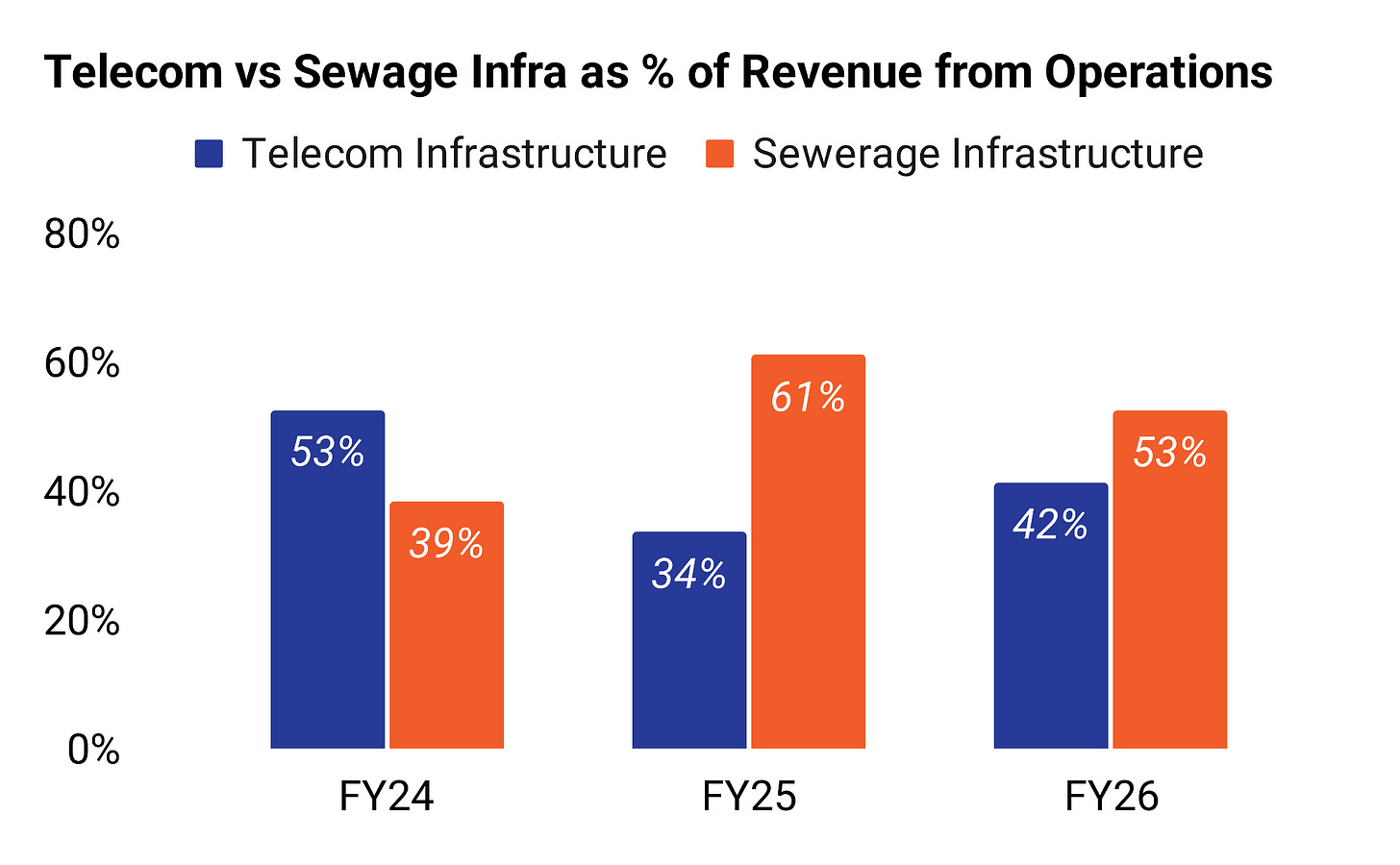
Telecom infrastructure and sewerage infrastructure between them have supplied more than 90% of revenue for the past 3 years.

Unit Economics (FY26, per Order basis)

- Construction expense is the single biggest cost per order, at 44% of order value, whereas material costs sit at 19%. Change in inventory and traded goods add a further 9% combined.
- Gross profit stands at ₹1.55 Cr per order, a margin of 28%. This is the cushion left after direct project costs, before the company pays its own people and overheads.
- Adjusted EBITDA per order comes to ₹1.17 Cr, a margin of 21%. Employee costs and other overheads take just ~7% of order value combined, so a decent chunk of the gross profit survives down to EBITDA.
Operating Metrics
- Order book value fell from ₹708 Cr in FY24 to ₹480 Cr in FY25, but then rose sharply to ₹939 Cr in FY26. Order intake in this business is lumpy, and tied to large contracts getting awarded instead of a typical smooth annual flow that other businesses might follow.

- Bid-to-win ratio swung from 20% in FY24 to 53% in FY25 and back to 33% in FY26, showing how much competitive intensity varies from year to year in government tenders. Though bid-win ratio was the highest in FY25, the order book actually sat at the lowest in that period.

- Telecom and sewerage infrastructure together have supplied over 90% of revenue in every year shown. Of the two, Sewage projects are accelerating at a greater rate in Annu’s portfolio, from 39% of revenue in FY24 to 53% in FY26.

The Financial Stuff

- Adjusted EBITDA rose from ₹29 Cr in FY24 to ₹50 Cr in FY26, a rise of 76% over two years.
- Finance Costs grew slower than EBITDA, staying roughly the same at ~₹4 Cr, so more of the EBITDA gain reached the bottom line rather than being absorbed by debt servicing.
- Profit After Tax rose from ₹17 Cr in FY24 to ₹33 Cr in FY26, an increase of 90%, with PAT Margin improving from 11% to 14% in the same period.
Annu Projects’ Peers (FY26)

- Annu’s EBITDA Margin of 21% beats three of four peers, Bondada, Likhitha, and EMS, but sits far below Suyog Telematics’ 74%.
- Annu’s PAT Margin of 14% is above Bondada and Likhitha, but again, below Suyog Telematics at 28%.
- On revenue scale, Annu at ₹241 Cr is the smallest of its peers. Bondada, the largest, is nearly 12x its size.
Key Risks
- Two verticals, ten customers: Telecom infrastructure and sewerage infrastructure supplied more than 90% of revenue, and top ten customers made up ~98% of revenue. Any slowdown anywhere could hit the company hard.
- Government terms for contracts: Between 57% and 65% of revenue over the last three years came from central or state government bodies and PSUs. These contracts carry fixed terms with little room to negotiate, expose the company to payment delays, and can be modified or ended at the government’s discretion.
Conclusion
Annu Projects is a mid-sized EPC contractor that has grown revenue and margins steadily since FY24, largely through two verticals and a small set of large customers and government counterparties. The business model rewards owning equipment and winning bids; it also carries concentration risk and receivable risks owing the governmental nature.