Symbiotec Pharmalab Limited is going for an IPO of ₹1,757 Cr from August 24th to 27th, 2026. Symbiotec makes active pharmaceutical ingredients (APIs), mainly corticosteroids and steroidal hormones, and holds the largest global volume share in this segment.
IPO Summary

Introduction
The global market for corticosteroid and steroidal-hormone active pharmaceutical ingredients is quite small and slow. Corticosteroid APIs (Active Pharmaceutical Ingredients) were worth $421 million in 2025, while steroidal-hormone APIs were worth ~$301 million.
Few companies want to compete for a market this size. Symbiotec Pharmalab has decided to dominate it instead.
Symbiotec holds a 38.2% global volume share in corticosteroid APIs and a 23.8% share in steroidal-hormone APIs. It is the only company in the world, Indian or otherwise, present across the top 10 products in both categories.
In three individual molecules, Hydrocortisone, Testosterone and Methylprednisolone, its market share tops 75%. This means that, literally, their business is the whole market itself.
Symbiotec is now going for an IPO consisting of a Fresh Issue of ~₹150 Cr and an Offer for Sale of ~₹16,07. Cr from August 24 to 27, 2026.
The Business Model
Symbiotec is a research and manufacturing company built on three connected platforms:
- organic chemistry,
- biotechnology, and
- complex injectables.
It uses these platforms to do two things.
First, it manufactures its own APIs and sells them to generic and specialty pharmaceutical companies.
Second, it manufactures products on contract for other companies, a business it calls CDMO, or contract development and manufacturing organisation.
The company follows a ‘microbe-to-pharmacy’ and ‘farm-to-pharmacy’ model.
Instead of buying finished chemical intermediates from outside suppliers, it makes many of its own key starting materials in-house, through fermentation and multi-step chemical synthesis. This backward integration gives Symbiotec control over cost and quality at each stage, and it reduces dependence on external suppliers for critical inputs.
Symbiotec earns the bulk of its revenue from selling its own APIs. In FY26, API sales made up 96% of revenue.
The company has over 60 corticosteroid and steroidal-hormone APIs in its portfolio, sold to over 200 customers in more than 40 countries.
The buyers of Symbiotec’s products are pharmaceutical companies who need a reliable, regulator-approved source of a hard-to-make ingredient. Its top five customers have been with the company for more than ten years on average, a sign of how sticky their business is.
Symbiotec is extending its model in two directions.
- It has commissioned a new fermentation facility at Ujjain, aimed at biologics such as GLP-1 and insulin
- It has developed a complex injectables facility at Mhow, aimed at double-chamber vials and similar drug-device combinations.
Unit Economics (per ₹100 of Revenue)

- Raw material cost per ₹100 of revenue has fallen from ₹44 in FY24 to ₹35 in FY26, which is in fact tracking after a shift in sourcing away from China.
- Employee cost per ₹100 of revenue has risen from ₹15 to ₹18, as the company staffed up new facilities at Ujjain and Mhow ahead of full commercial output.
- Adjusted EBITDA per ₹100 of revenue has improved from ₹24.91 to ₹27.72 over FY24 to FY26, as a result of lower costs.
Operating Metrics
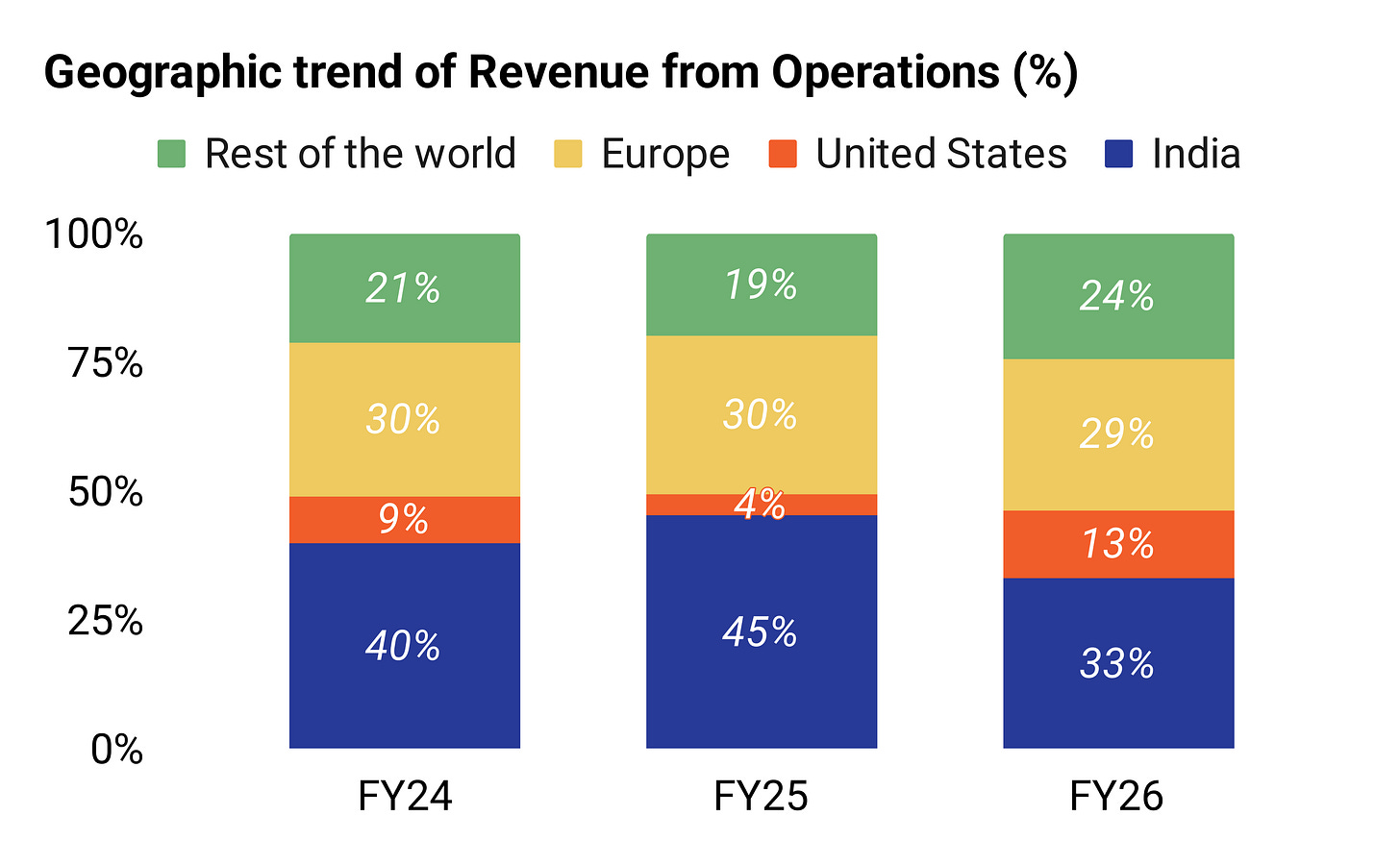
- Revenue from the United States tripled, from 4% in FY25 to 13% in FY26. However, American tariffs pose the greatest risk to Symbiotec’s business.
- China’s share of Symbiotec’s Total Expenses has fallen sharply from 53% in FY24 to 24% in FY26.


- Testosterone share nearly doubled in two years, from 42% in FY24 to 76% in FY26, the sharpest gain of within Symbiotec’s entire portfolio.

The Financial Stuff

- Revenue from operations grew from ₹716 Cr in FY24 to ₹869 Cr in FY26, a rise of ~21%, driven mainly by higher volumes.
- Adjusted EBITDA Margin expanded each year, from 25% in FY24 to 28% in FY26, while PAT Margin stayed roughly the same.
- Finance Costs more than tripled, from ₹7 Cr in FY24 to ₹25 Cr in FY26, as borrowed money funded new capacity. This is a big reason why PAT Margins fell even as Adj. EBITDA Margins rose.
Symbiotec’s Peers (FY26)
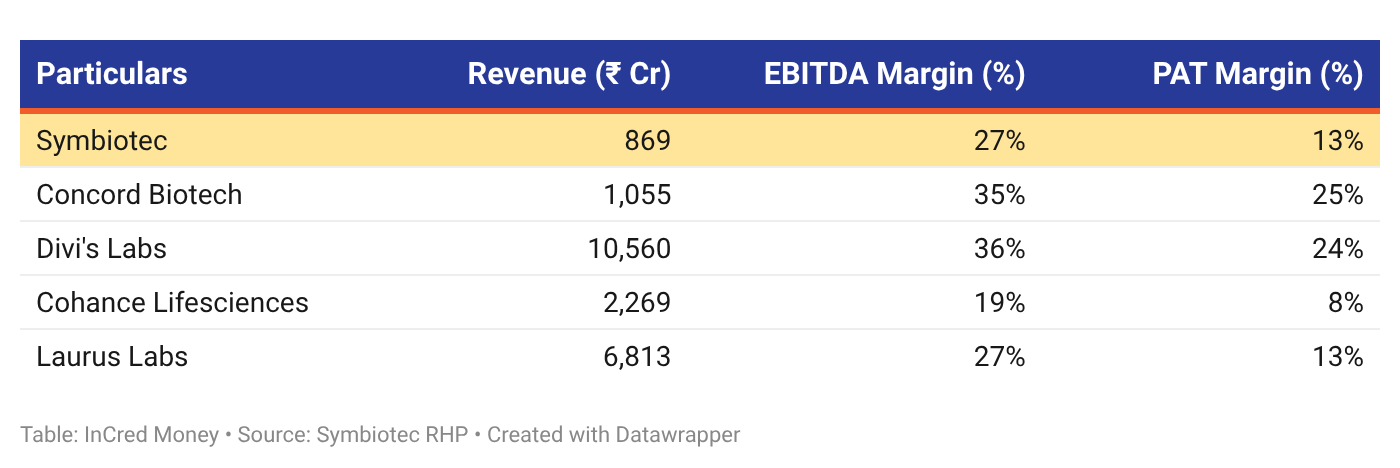
- Symbiotec’s EBITDA Margin of 27% sits below every peer except Cohance Lifesciences.
- On PAT Margin, Symbiotec at 13% trails Concord Biotech and Divi’s Labs, but beats Cohance Lifesciences.
- Symbiotec is also the smallest company in the set by revenue, at less than tenth the size of Divi’s Laboratories and less than a sixth the size of Laurus Labs.
Key Risks
- Product concentration: Symbiotec’s top five products make up ~62% of revenue, and its top five customers also make up ~43%. Loss of demand for even a few of these products, or the loss of a single large customer, could have an outsized negative impact.
- Dependence on China: China accounted for 24% of total expenses in FY26, down from a peak of 53% in FY24, but still a material share. Any disruption in Chinese supply, whether from trade restrictions or geopolitical tension would raise material costs.
- Regulatory and facility risk: The US FDA concluded an inspection of the Pithampur facility on August 14, 2026 and issued four observations. Since API manufacturing depends on regulatory approval, serious adverse findings could disrupt supply.
Conclusion
Symbiotec has built a dominant position in a small, slow-growing corner of the API market, and is now spending heavily to push into faster-growing biologics and complex injectables. The core API business is stable and sticky, but margins and returns on capital stand to improve still with respect to peers.