
In 1988, Jim Simons started a quantitative hedge fund called Renaissance Technologies. He wasn’t a trader or a banker. He was a mathematician who’d spent years breaking Soviet codes for the government.
Then Renaissance established the Medallion Fund along with other mathematicians. Average annual returns of 66% before fees over three decades.
Simons didn’t outwork anyone. He had no better tips, no floor connections. What he had was code i.e. algorithms running 24 hours, finding patterns humans couldn’t see, compounding quietly while he slept. He took his greatest advantage and multiplied it through systems that never tired.
It comes down to one word most people misunderstand: leverage.
The Fulcrum
In physics, a lever moves a large load with a small force, with a fulcrum in between.
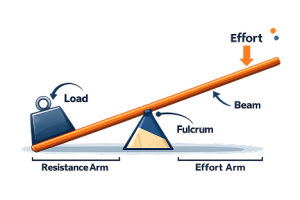
The fulcrum is what makes everything else work.
Move it closer to the load and the same effort suddenly shifts ten times more weight. In life, the fulcrum is your positioning – the specific place where your skills meet an underserved problem that almost nobody else is occupying.
Simons’ fulcrum wasn’t mathematics. It was mathematics applied to financial markets, where nobody else was looking. That placement changed everything.
Most people spend their careers adding effort. Same lever, same position, and the load barely moves. The question isn’t just how hard you push. It’s where you’re standing when you do.
Naval Ravikant, who co-founded AngelList and backed Uber, Twitter, and Notion early, breaks leverage into four types.
Before I get into these types of leverage, I want to clarify a little more about this word. Leverage has another meaning in finance: taking on debt to amplify returns. That kind of leverage is real, and it’s risky. It’s why people lose houses and why funds blow up. Here, I am not talking about financial leverage but some other forms of leverage.
Labour Leverage is the oldest kind. Henry Ford didn’t build cars. He built a system of people who did. Today it looks like hiring or outsourcing to do things that used to eat your hours. Your time is finite. A system isn’t.
Capital Leverage is Warren Buffett’s entire game. Every rupee invested becomes a tireless worker that never sleeps and quietly compounds. Even ₹500 a month into a low-cost index fund, automated and started today, does something that feels almost unfair after twenty years. But Buffett’s real fulcrum wasn’t money, it was starting early and letting time do what time does.
Media Leverage is your reputation working while you aren’t. Consider MrBeast, who reinvested every dollar he made on YouTube back into bigger videos for years before most people had heard of him. Today he runs one of the most-watched channels on earth, a chocolate brand, a burger chain, and a philanthropy operation — all powered by the same asset: an audience of hundreds of millions that follows him. The content was the fulcrum. Everything else followed.
Code Leverage is software working at near-zero marginal cost around the clock. WhatsApp was sold to Facebook for $19 billion with just 55 employees serving 450 million users. With the advent of AI, it has become easier to start building your own apps and systems – either for personal use or commercially.
Putting it all together
Stack these leverages together. That’s where the real distance gets created.
Simons stacked code and capital, a fulcrum in a market nobody else was treating scientifically. Then there is Buffett, who stacked capital and media (Berkshire annual report which every investor wait more, and more). Most of us trade hours for income on a single lever, hit a ceiling, and assume we need to work harder. Usually, the fulcrum is just in the wrong place.
Leverage is not just about taking on debt. Leverage is taking what you already have; your skills, your savings, your name, your systems, and making it multiply.
Start small: automate one habit, publish one useful piece, build one repeatable system. Then stack another.
Over time, those quiet, compounding choices beat raw effort every time. That’s what leverage really means. And now you can use it too.
If you enjoyed this newsletter, feel free to share it with your friends and family
Till the next time,
Vijay
CEO – InCred Money