
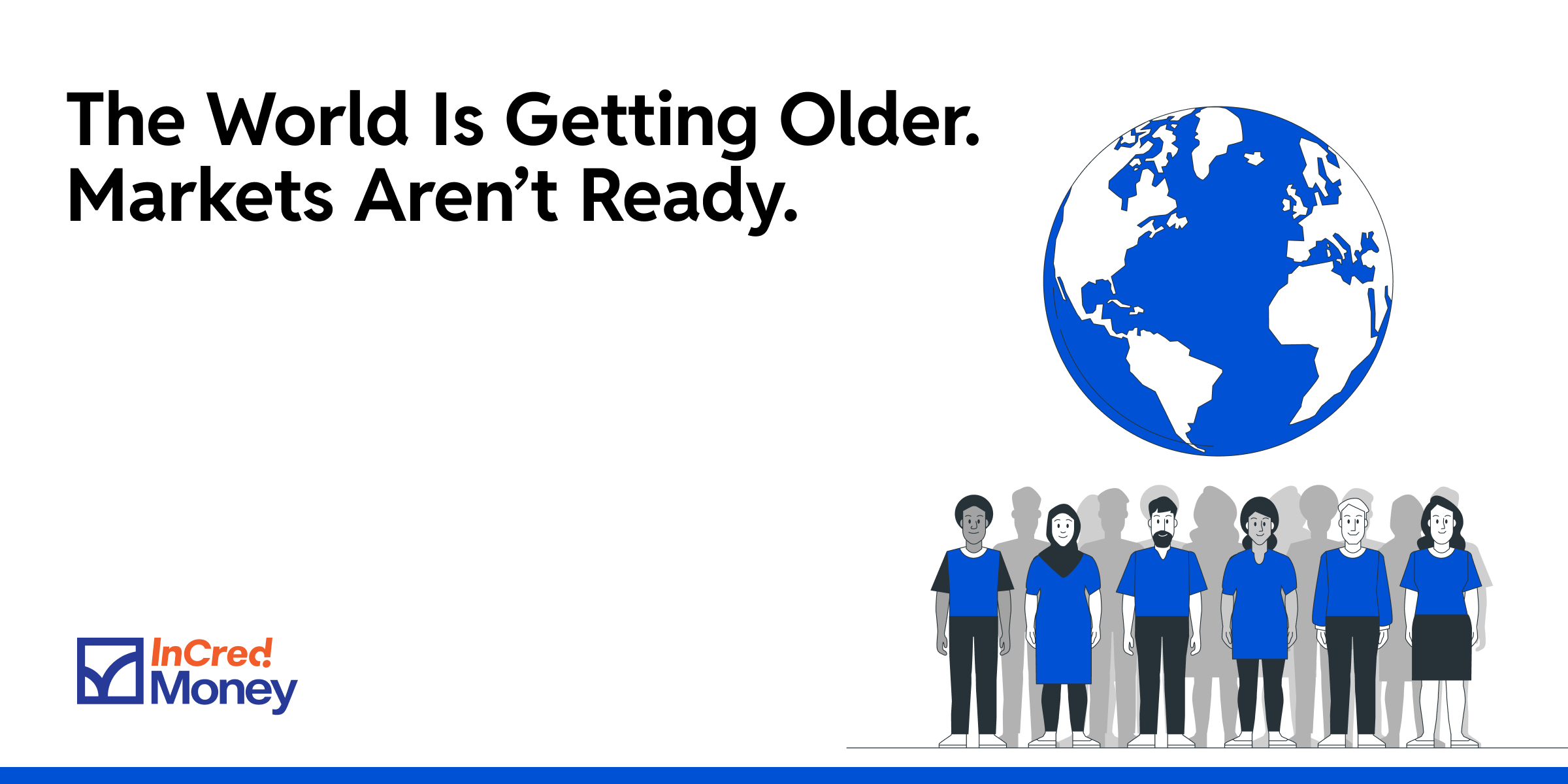
For decades, the world worried about having too many people. In the 1960s, books like The Population Bomb warned of famine, chaos, and a planet stretched beyond its limits. The fear was simple: humanity was growing faster than the Earth could cope.
Fast forward to 2025, and the anxiety has flipped on its head.
Elon Musk tweeted a few years back that “population collapse is a much bigger risk to civilization than global warming.” He calls it an underpopulation crisis — a slow-motion threat that could hollow out economies.
But here’s the catch: the world isn’t shrinking uniformly.
We are entering an era of Demographic Divergence — where one part of the world is rapidly turning grey (the Global North), while another remains young, restless, and growing (the Global South).
A Grey Global North
The ‘crisis’ Musk talks about is largely a Global North problem — spanning North America, Europe, Japan, South Korea, and now even China.
South Korea’s total fertility rate has collapsed to about 0.7 — nearly one-third of what’s needed to keep its population stable. Japan and much of Europe are already shrinking. China, after decades of its one-child policy, has joined the club.
The result is a demographic inversion. Too many retirees. Too few workers.
Governments are staring at ballooning pension bills, rising healthcare costs, and a shrinking tax base. The population pyramid has flipped upside down and fixing it is not easy. Incentives to have more children sound good, but till now it’s not been very successful in the countries where it has been implemented.
A Green and Growing Africa
While the Global North ages, Sub-Saharan Africa tells a completely different story.
Countries like Niger, Somalia, and Chad still have fertility rates between five and six. Populations are young, fast-growing, and increasingly urbanising. By the end of this century, one in every three people on Earth will be African.
While capital, technology, and wealth remain concentrated in aging economies, Youth, labour, and future consumers are concentrated elsewhere — mainly Africa and South Asia. This geographic mismatch may become one of the defining tensions of the global economy.
Why Demographics become a Market Problem
Demographics are an asset-pricing problem. Equity markets are built on one core assumption: that there will be growth.
At its simplest, economic growth comes from two levers — workforce growth and productivity growth. When the workforce expands, economies grow naturally. When it shrinks, productivity has to work overtime just to keep GDP flat.
That’s the bind much of the developed world now finds itself in.
With fewer workers entering the system, the margin for error disappears. Productivity must rise sharply, year after year, or long-term growth — and equity returns — get squeezed.
India: Caught Between Two Worlds
India sits in a rare demographic sweet spot.
We are no longer as young as Africa, but not yet as old as the West. We still have a few years left before aging becomes a serious macro constraint
But this demographic ‘Goldilocks zone’ also comes with India’s internal contrasts.
Southern states like Kerala and Tamil Nadu already resemble aging developed economies, with low fertility and rising dependency ratios. Meanwhile, states like Bihar and Uttar Pradesh look more like the youthful Global South, supplying labour and future consumers.
The Investor’s Playbook: Positioning for a Greying World
If the world is splitting into aging capital-rich regions and young labour-rich ones, capital allocation needs to follow that reality.
One obvious response is to invest where aging itself creates demand. As populations grow older, spending shifts toward healthcare, pharmaceuticals, diagnostics, assisted living, and chronic disease management. At the same time, the “young-old” cohort — people in their late 60s and early 70s — controls a disproportionate share of wealth in developed markets. They are retired, healthy, and willing to spend on leisure, travel, and financial services.
Another approach is more aggressive: invest in productivity itself.
With fewer workers available in the West and China, automation is no longer optional — it’s existential. Robotics, industrial automation, AI agents, and enterprise software are not just technology themes; they are direct responses to labour scarcity. Any company that allows one worker to do the job of three will increasingly command premium pricing.
Finally, growth investors must look beyond the usual suspects.
If consumption flattens in aging economies, new demand will come from elsewhere. India and Vietnam stand out as manufacturing beneficiaries as supply chains move away from aging China. Meanwhile, Africa’s urbanisation creates massive demand for physical infrastructure — cement, steel, power, logistics, housing, and transportation.
That’s where real volume growth will be built.
The Final Takeaway
The world isn’t running out of people. It’s just running out of people in the same places.
Some countries are getting older and slower. Others are getting younger and bigger. That gap will shape where growth comes from in the years ahead.
For investors, this may mean return won’t come automatically in the long term anymore. You’ll have to be clear about what you’re backing — technology that replaces workers, services for aging populations, or countries where the workforce is still growing.
The world is changing quietly. Portfolios will need to change with it.
Do you agree?
If you enjoyed this newsletter, feel free to share it with your friends and family using the link below.
Also, if you have any topics that you would like us to cover or any other feedback, do write to us at connect@incredmoney.com
Till the next time,
Vijay
CEO – InCred Money