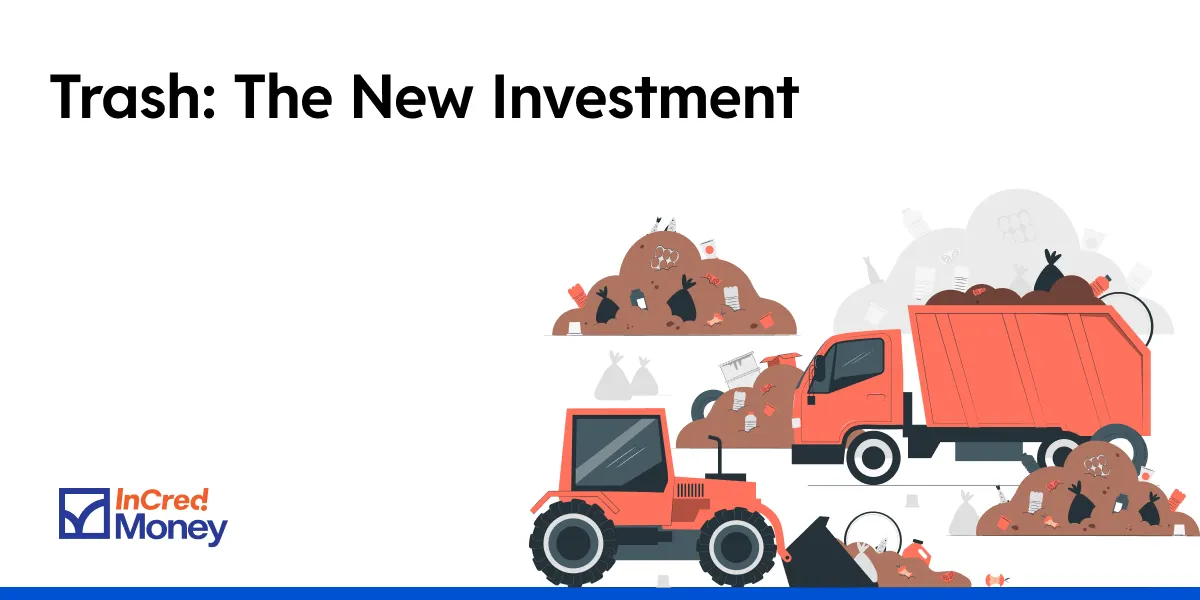
Every morning, a garbage truck quietly disappears down your street. Out of sight, out of mind. But where does it all go?
Mostly to an open dumping ground somewhere on the outskirts of your city, piling up, slowly rotting, and releasing methane into the air. Delhi’s Ghazipur landfill is already taller than the Qutub Minar. Mumbai’s Deonar dump has been on fire, literally, more times than anyone would like to count.
And while that sounds like an environmental problem, it is increasingly a business one too. The global waste management market is worth over $1.2 trillion a year, and it is growing. Quietly, without much fanfare, an entire economy is building around what we throw away.
Why Waste Is Becoming a Bigger Problem
India is urbanising fast. More people in cities means more consumption. More consumption means more packaging, more electronics, more food, more plastic.
India generated around 62 million tonnes of solid waste in 2024. By 2050, that number is expected to cross 165 million tonnes. Meanwhile, landfill capacity is already near its limits in most major cities.
The problem is not just the volume. Miniscule percentage of India’s waste is formally processed. The rest is either dumped, burned in the open, or handled by an informal network of waste pickers with no safety gear and no formal recognition.
What Are We Actually Throwing Away?
Not all waste is the same, and not all of it is a problem. Some of it is a resource waiting to be tapped.

How the Waste Economy Works
Waste management is not one business. It is a chain of businesses, each capturing margin at a different step.
The first layer is collection and transportation, moving waste from where it is generated to where it will be processed. This is often run by municipalities under long-term contracts. Margins are thin but revenues are stable and recurring.
The second layer is processing and treatment. This is where the real value is created. Waste-to-energy plants burn municipal waste to generate electricity. Sewage treatment plants process wastewater and return it for reuse. Material recovery facilities sort mixed waste into recyclable streams. Hazardous waste processors use incineration and chemical treatment to neutralise industrial effluents.
The third layer is recycling and resource recovery, where processed material is converted back into usable raw material: lead from battery scrap, rPET chips from plastic bottles, recovered carbon black from old tyres, copper from e-waste.
Here’s how the waste management flow looks like:

The real money is not in collection. It is in processing and recovery, where technology, scale, and efficiency determine who makes money and who does not.
Regulatory tailwinds are also reshaping this economy. India’s Extended Producer Responsibility (EPR) framework now requires companies that sell plastic, electronics, and batteries to ensure a portion of that material gets recycled. Brands are now paying recyclers to take their waste, which has introduced a second revenue stream, on top of the commodity value of the recovered material.
Who Are the Active Players?
The Indian listed market has a reasonable set of companies spread across different parts of the waste economy.

On the private & unlisted side, Attero Recycling (e-waste and battery metals) and Ramky Enviro Engineers (hazardous industrial waste) are two of the bigger names.
One thing that stands out is the absence of India’s large conglomerates in this space. No Tata Ambani and the likes with a serious waste management play. That could change, and if it does, it would bring both capital and visibility to a sector that has largely flown under the radar.
What Are the Risks?
The structural story is compelling. But a few things could disrupt it.
The two risks that matter most are commodity prices and capital intensity.
Recycling economics are directly tied to the market price of output materials. If lead, copper, or rPET prices fall sharply, processor margins compress fast, and there is no hedge built into most of these businesses.
Processing plants also cost a lot to build and take time to ramp. Many companies in this space are still deploying capital with returns that show up years later, which means free cash flow can look thin even when the underlying business is doing the right things.
The Megatheme
A few structural forces make this more than a feel-good story.
Raw material security is becoming a national priority. Countries that can recycle their own lithium, copper, and rare earths need less from geopolitically sensitive supply chains.
India’s EPR rules for plastics, batteries, and electronics have created guaranteed demand for formal processors — a rare case where regulation is creating a market, not constraining one. And as commodity prices stay elevated, the economics of recovered material keep improving.
The investment space in this sector is very diverse with each players specializing in different segments. The investor who succeeds will be the one that picks the right part of the chain and waits for the right entry.
If you enjoyed this newsletter, feel free to share it with your friends and family using the link below.
Till the next time,
Vijay
CEO – InCred Money
P.S. I share my thoughts on Investing and the Economy regularly. You can follow me here.