On 10th May, PM Modi urged Indians to reduce the consumption of a few items. One of those items was edible oil. One may be forgiven for thinking that the message was for us to become healthier.
But that wasn’t really the point. He was making an economic argument. Every litre of cooking oil poured in an Indian kitchen is, to a significant degree, an imported litre. And the country is spending a lot on it.
India spent $19.5 billion (~1.7L+ Cr) importing edible oils (on a net basis) in FY26 alone, making it one of the largest items in our import basket. To put that into perspective, we net imported Petroleum & Crude products amounting to $120 Bn and Gold amounting to $72 Bn in FY26.
India’s merchandise trade deficit (import of goods minus exports) in FY26 was roughly $333 billion. Edible oil alone contributes ~6% of that.
While we all know that too much consumption of oils is bad for our health, in this newsletter, we will also learn why it’s bad for India’s economic health.
From Biscuits to Samosa
Edible oils are everywhere you look.
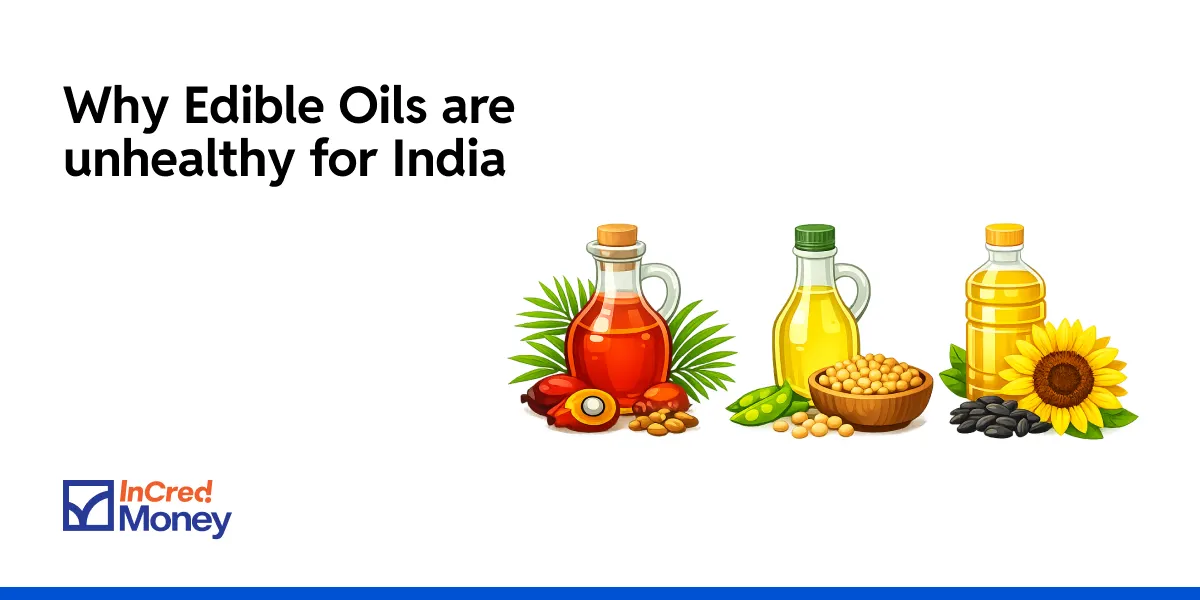
Most people think edible oil = cooking oil. But that’s just one part of the story. Palm oil, India’s single largest edible oil import, turns up across your entire day, mostly without you realising it.

The biscuits, the instant noodles in your kitchen, the samosas during your Friday office party, all have edible oil woven into them. And most of that oil started its journey on a plantation in Indonesia or Malaysia.
What India Consumes
India consumes roughly 24–25 million tonnes of edible oil a year. That’s about 19.7 kg per person per year, significantly above the 12 kg annually recommended by ICMR. Of this, nearly 60% is imported.

Palm oil is the dominant one. It’s cheap, versatile, and has a long shelf life, which makes it the industry’s go-to. Mustard oil is largely grown domestically and is a strong regional preference in North and East India. Soybean and sunflower oils are almost entirely imported.
The Import Bill: A $19.5 billion hole in our trade balance
India produces around 9.5–9.6 million tonnes of edible oil domestically. It consumes roughly 24–25 million tonnes. The gap of over 14 million tonnes is filled by imports.
The chart below shows how domestic production has barely moved, while imports continue to carry the weight of feeding India’s growing appetite.

The 2022-23 spike tells its own story, Russia’s invasion of Ukraine knocked out global sunflower oil supply, Indonesia briefly banned palm oil exports, and post-Covid demand surged. India’s import bill jumped in step.
Where does it all come from?
Nearly all of India’s palm oil, the single biggest item, comes from just two countries.

That concentration is a vulnerability. Three commodity corridors: Southeast Asia, South America, and Ukraine/Russia, determine what Indians pay for cooking oil. If any one of them runs into trouble, the ripple reaches every kitchen in the country.
India’s Plan to become Aatmanirbhar
The government has been trying to fix this problem for years. The current push runs under the NMEO, National Mission on Edible Oils, with two separate tracks.
Track 1: Oil Palm (NMEO-OP, launched 2021) India produces some palm oil domestically, mostly in Andhra Pradesh, Telangana, and parts of the Northeast. The NMEO-OP aims to expand this significantly, offering farmers a price support mechanism (similar to an MSP) to insulate them from global price swings.
Track 2: Oilseeds (NMEO-OS, launched 2024) This focuses on mustard, soybean, groundnut, and sunflower — the crops Indian farmers already grow. A ₹10,000 crore programme over seven years, aimed at better seeds, higher yields, and getting more land under oilseed cultivation.
Progress exists, but the numbers are sobering. Oil palm coverage has grown from 3.7 lakh hectares in 2020-21 to 6.2 lakh hectares today — but the target was 10 lakh hectares by 2025-26. Total domestic edible oil production has crept up from 8.7 MT to 9.6 MT over the same period, against a target of 20.2 MT by 2030-31.
On palm oil specifically, India is roughly 14% of the way to its 2029-30 production target. The structural constraint is simple: oil palm trees take 4-5 years to yield commercially. Land planted today won’t produce meaningful oil before 2030. Even under the most optimistic scenario, analysts estimate India will still need to import 7-8 MT annually by then.
Why Indonesia and Malaysia could make your grocery bill worse
Even as India works to grow more oil at home, the two countries supplying most of its palm oil are facing problems of their own.
Indonesia – Biodiesel Mandate
Indonesia’s B40 mandate (40% palm oil blended into diesel) already diverts ~2 million tonnes of Crude Palm Oil (CPO) away from exports annually, with discussions underway to push this to B50.
Malaysia – Ageing Trees & Stalled Output
Malaysia’s mature oil palm acreage has declined for four consecutive years. Older trees yield less, the industry is heavily dependent on migrant labour, and production growth has essentially stalled. Malaysia’s 2026 CPO output is forecast to fall from 2025 levels.
Any supply tightening from either country feeds directly into global palm oil prices, and palm oil prices have shown they can move fast. They nearly doubled between 2020 and early 2022, then halved by late 2023, before climbing again through 2024.
The rupee adds another layer of risk. Edible oil is priced in US dollars globally. So India’s import bill is hit twice when things go wrong: once when global palm oil prices rise, and again when the rupee weakens against the dollar.
The Takeaway
Edible oil might not feel like a big-picture economic issue. But it’s sitting at the intersection of food security, inflation, and trade policy. The $19.5 billion we send abroad every year for oil is money that could otherwise stay in the country.
India’s direction, growing more oil domestically, is right. But the timeline is long, and the targets are ambitious.
In the near term, what happens in Jakarta and Kuala Lumpur matters as much as what happens in Delhi. Any disruption to Southeast Asian palm supply, whether from biodiesel policy, land disputes, or weather, flows directly into your grocery bill.
And so it’s in our interest to heed PM Modi’s message to eat less oil, for our health and India’s.
If you enjoyed this newsletter, feel free to share it with your friends and family using the link below.
Till the next time,
Vijay
CEO – InCred Money
P.S. I share my thoughts on Investing and the Economy regularly. You can follow me here.