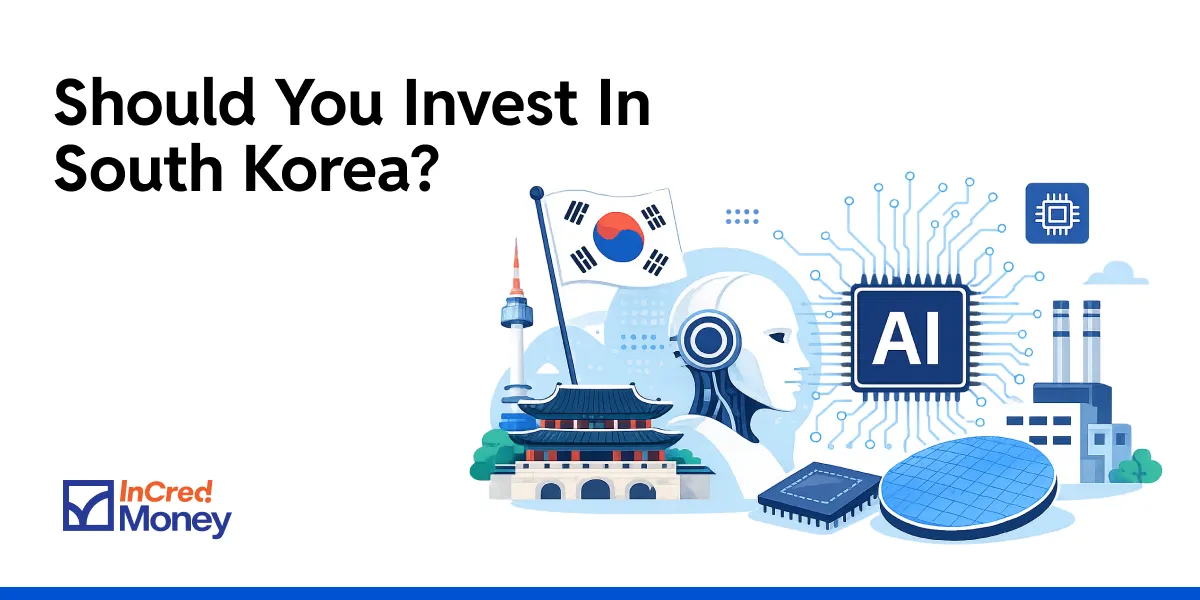
Something unusual is happening in a market most Indian investors have never looked at. South Korea’s KOSPI (Korea’s stock market index) delivered more than 75% returns in 2025, making it the world’s top-performing major index. Most people assumed that there would be some sort of correction coming up. Then 2026 happened. Just by the end of May, the KOSPI has almost doubled year-to-date!
And if you look at the last 1 year returns alone, they were a humongous 210%+. That means the index tripled itself in just 1 year.

That is a really rare phenomenon and that’s why in this newsletter we are breaking down this rally and what the future looks like for the KOSPI.
But before that, let’s look at a little history.
From war rubble to chip powerhouse — 70 years
In 1953, South Korea ended the Korean War as one of the world’s poorest nations. GDP per capita was below most of sub-Saharan Africa. And unlike African countries, Korea wasn’t blessed with the abundance of natural resources as well.
What followed was a deliberate act of state engineering. President Park Chung-hee’s government in the 1970s decided that Korea would industrialise by force. They did so by channeling cheap bank credit to a handful of chosen conglomerates, shielding them from foreign competition, and giving them government contracts.
The deal was simple: take the money, hit the export targets, or lose the funding. Samsung at the time was a textile company while Hyundai was in construction.
These companies then started spreading their wings and became the big conglomerates they are today. Steel, shipbuilding, and heavy industry were built from scratch.
Then in the 1980s, Samsung made a high-risk bet on DRAM memory chips. By the mid-1990s, Korea was the world’s #1 chip producer. The 1997 Asian financial crisis forced painful restructuring, but it hardened the economy. By the 2000s, Korea had added K-pop, cinema, beauty and gaming to its export portfolio.
Chaebols — the conglomerates that ARE Korea
A Chaebol is a large, family-controlled industrial conglomerate. Built through government patronage in the 1960s-70s, they became global giants and never let go of the economy. Samsung (~25% of KOSPI) and SK Group via SK Hynix (~17%) alone represent nearly half of the entire index. Hyundai, LG, and Lotte make up most of the rest.
Historically, Chaebols traded at lower valuations than global peers known as the “Korea Discount” due to opacity and hereditary leadership. The current government has been pushing corporate governance reforms which mandate companies to conduct buybacks, dividends, and simplify holding structures.

Note: The ranges are subject to change based on market movements.
A Country reliant on Exports
Semiconductors and electronics alone account for ~30% of Korea’s total exports. In 2025, record exports hit $709 billion, with AI infrastructure demand pushing chip volumes higher than at any prior point in history.

(Note: Current Account surplus refers to a country exporting more than what they are importing. For context, India runs a Current Account deficit which was ~0.8% of GDP in H1 FY26).
The Big AI Beneficiary
The AI story has largely been told through GPUs — Nvidia’s H100s, B200s. But there’s a second chip that sits right alongside every GPU in every data centre: High Bandwidth Memory, or HBM.
HBM is the memory that allows AI models to process data at the speed they need.
9 out of every 10 HBM chips in the world are made in South Korea. SK Hynix is the global #1 supplier. Samsung is #2. Together, they are the unavoidable chokepoint in the AI supply chain.
This isn’t a temporary edge. HBM requires extraordinarily complex stacking of memory dies — a technology that took Korea decades to perfect. New entrants face a 5-10 year learning curve.
Every time a hyperscaler like Microsoft, Google, Amazon, Meta orders more AI servers, some of that money flows to Korea.
Goldman Sachs has revised Korea’s 2026 profit growth forecast three times already this year, most recently to 130% because actual demand kept beating estimates.
Despite a 100% YTD rally, the KOSPI still trades at just 8.8x 2026 earnings and 7.8x 2027 earnings — a meaningful discount to emerging markets. Even stripping out Samsung and SK Hynix entirely, the rest of the market trades at ~12.9x. Valuations haven’t gone crazy.
Source: Goldman Sachs, FXStreet (March 2026)
Post March, we have seen the KOSPI rally a lot more, but even then, the valuations on a 2026 basis are relatively lower.
But everything is not rosy – The demographic time bomb
This is the part that tends to get skipped when someone talks about Korea nowadays.
South Korea has the world’s lowest fertility rate, 0.72 in 2026, against a replacement level of 2.1. For context, India sits at 1.9. Korea’s rate is less than a third of what’s needed to maintain its population.
The fertility rate has fallen almost every year for two decades, driven by sky-high housing costs, high costs to raise a child, and a job market that makes long-term planning feel impossible for young Koreans.
The consequence is a population that is simultaneously ageing and shrinking.
This was one of the reasons why Korea wasn’t an attractive market before the AI trade took place.
Korea is best understood as a cyclical market, not a structural compounder. The underlying macro will not compound the way India’s young demographic will. This is not a set-and-forget market.
Source: IMF, Worldometer
Bull Case vs Bear Case

A rally led by SK Hynix and Samsung

What does all this mean for you?
For Indian investors, direct Korean stock buying is not straightforward. The practical route is US-listed ETFs, accessible via international investing platforms.
Is this Rally Sustainable?
Partially yes, partially no.
The AI trade is real. SK Hynix’s HBM position is genuinely hard to replicate while Samsung’s scale is unmatched. The government’s governance push has credibility. So, these are not artificial (but artificial intelligence) tailwinds.
But this is a cyclical market, not a structural one. The KOSPI has seen strong bull runs before followed by sharp corrections. The semiconductor cycle can turn and the Hyperscalers can cut capex. For the rally to sustain, AI capex has to continue at the same speed or faster to support earnings and hence the stock prices.
The demographic headwind won’t reverse and Korea will not compound the way a young-population economy would.
And that’s why timing the entry and exit becomes extremely crucial.
If you enjoyed this newsletter, feel free to share it with your friends and family using the link below.
Till the next time,
Vijay
CEO – InCred Money
P.S. I share my thoughts on Investing and the Economy regularly. You can follow me here.