SS Retail is opened its ₹500 Cr IPO on September 16, 2026. Its average store measures just 480 square feet, yet its 503 outlets make it the largest mobile phone retail chain in West India and Maharashtra, and the third largest in India, by store count.
IPO Summary
SS Retail IPO Details
IPO Date
16th Sep to 18th Sep, 2026
Sale Type
Fresh Issue + OFS
Tentative Listing Date
23rd Sep, 2026
Price Band
₹403 to ₹424
Post Issue M. Cap at ₹424
₹3,153 Cr
Total Issue Size
₹500 Cr
Industry Overview
India’s mobile phone market is growing with rising average selling prices and a shift towards premium smartphones.
Tier II and tier III cities are growing faster than metros, and the pre-owned smartphone segment, worth roughly ₹88,000 Cr in FY26, is expanding even quicker, at a projected 12.7% CAGR to FY30.
Regional multi-brand retail chains have captured a growing share of this expansion, particularly in tier II and beyond cities where national chains have a thinner footprint.
SS Retail is one such chain and operates as the largest mobile phone retailer in West India and in Maharashtra, and the third largest in India by store count.
Business Model Explained
SS Retail Limited was incorporated in Kolhapur, Maharashtra in June 2016, and it runs a multi-brand retail chain for mobile phones, accessories and other electronic items.
Source: RHP
As of March 31, 2026, it operated 503 stores across 215 cities in five states: Maharashtra, Karnataka, Madhya Pradesh, Goa and Gujarat (the last one entered in FY27), of which 458 stores sit in Maharashtra alone.
The company sells under three brands:
1. SS Mobile is the flagship, retailing phones, accessories and electronics through large, medium and small format stores.
2. Mobile Exchange Wala, launched in FY23, is a shop-in-shop format for pre-owned smartphones operating inside SS Mobile stores.
3. The Mobile Space, launched in FY23, targets tier II and III cities through medium and small format stores.
In FY26, the company acquired a 51% stake in Olineo Nexus India, adding 34 stores in Maharashtra, and set up subsidiary Nexora Smart Tech to sell accessories on B2B basis.
Stores run under three models: 1. Company-owned and company-operated (COCO) – here SS retail bears full running cost of operations. 2. Company-owned and franchisee-operated (COFO)
3. Franchisee-owned and franchisee-operated (FOFO)
Inventory ownership stays with the company under all three.
Unit Economics
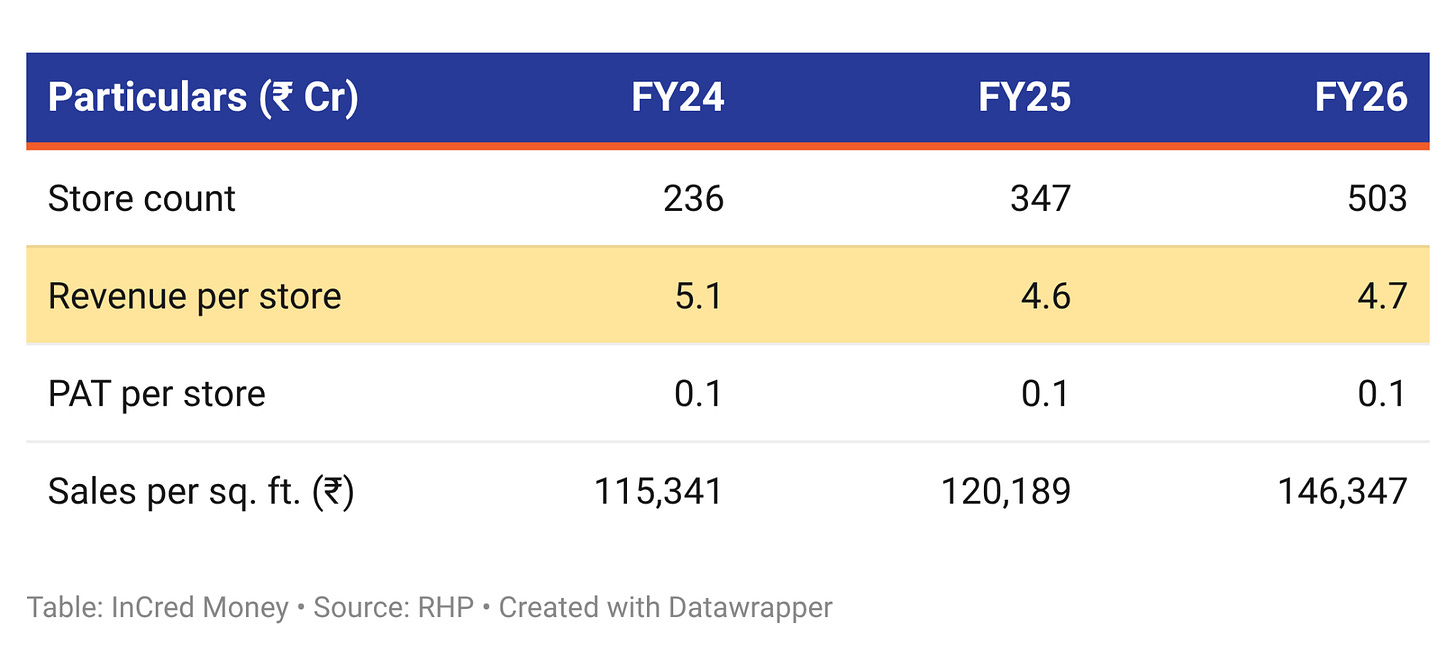
Revenue per store dipped from FY24 to FY25 even as total revenue grew, because the store base itself grew 47% in a single year, and the newly opened stores are not yet contributing to revenue base.
Despite that EBITDA and PAT per store held broadly steady across all three years.
Sales per square foot jumped 22% in FY26 as higher-margin (Mobile Exchange Wala) scaled within existing store space rather than through new floor area.
Operating Metrics
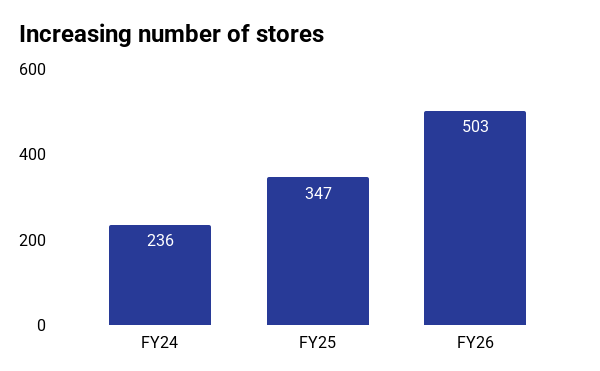
Store count: The number of stores has increased every year.
Source: RHP
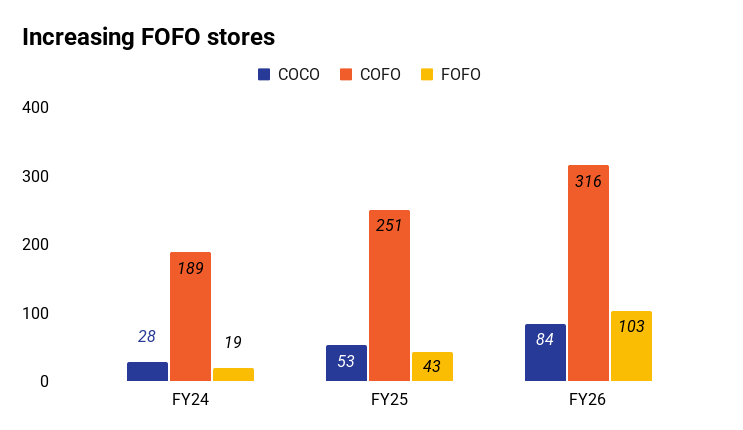
Store count by business model: COFO and FOFO, both franchise-led and asset-light for the company, together account for 83% of stores in FY26. The FOFO share has grown fastest, more than doubling from 8% to 20% of the network, shifting more of the store-level capital burden onto franchise partners.
Source: RHP
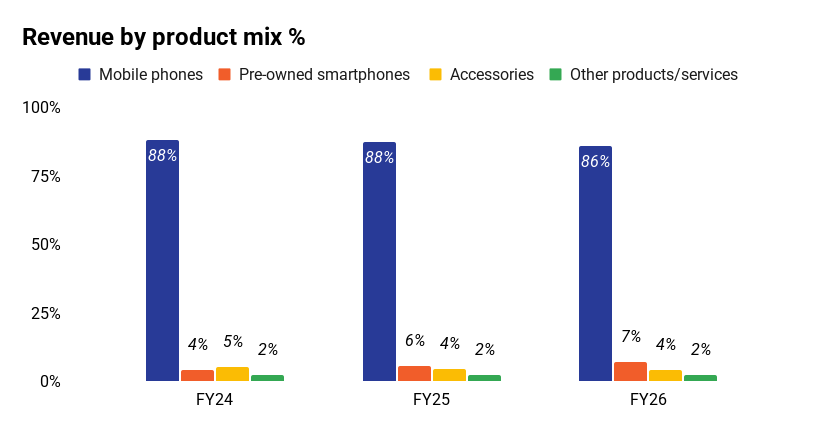
Revenue mix by product category: Mobile phones still dominate revenue, but their share has eased over three years as pre-owned smartphones nearly doubled their share from 4% to 7%.
Source: RHP
Financial Stuff: From Revenue to PAT
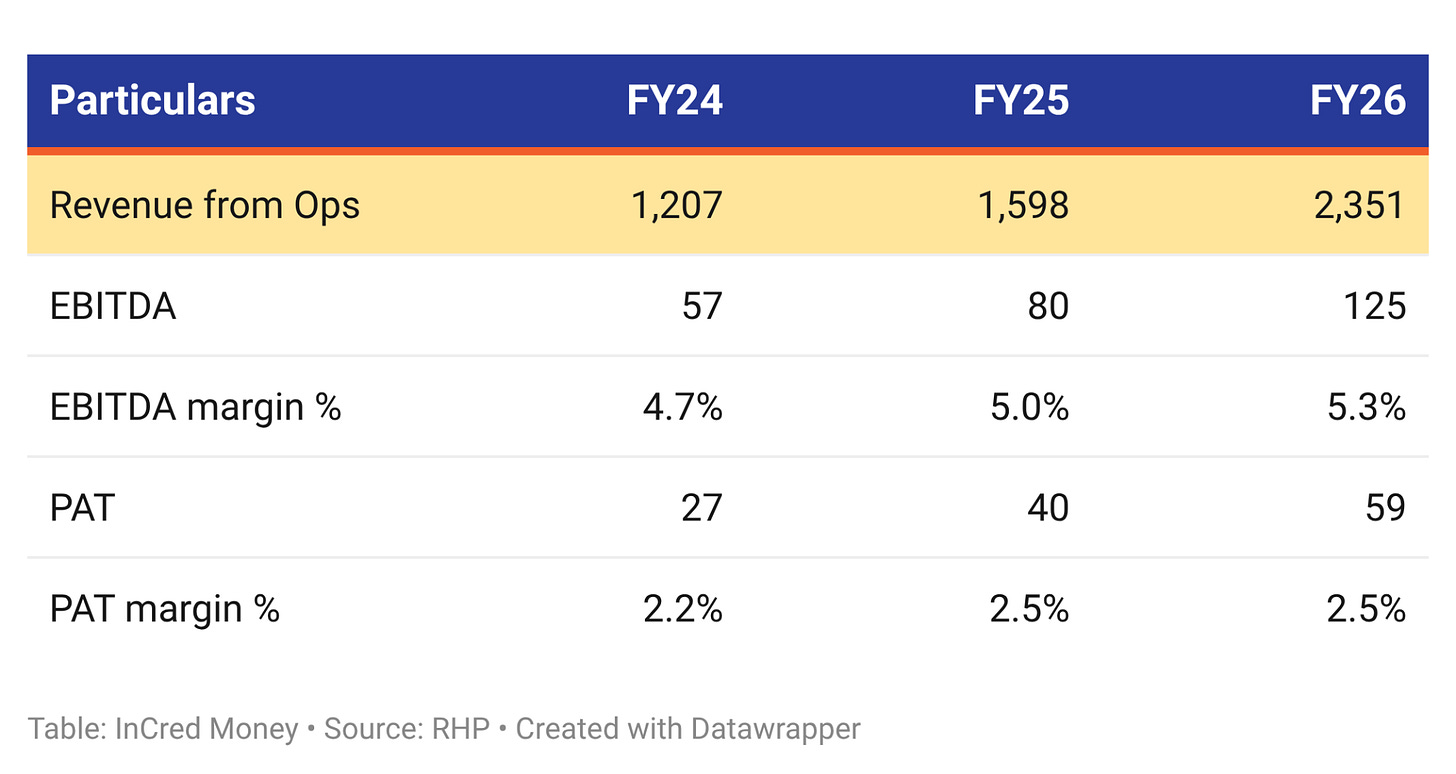
Revenue grew at a 40% CAGR between FY24 and FY26 which was the highest among their peer set.
Margins expanded every year rather than staying flat as the company added stores and shifted its mix towards the higher-margin pre-owned smartphone and accessories categories.
Peer Comparison – FY26
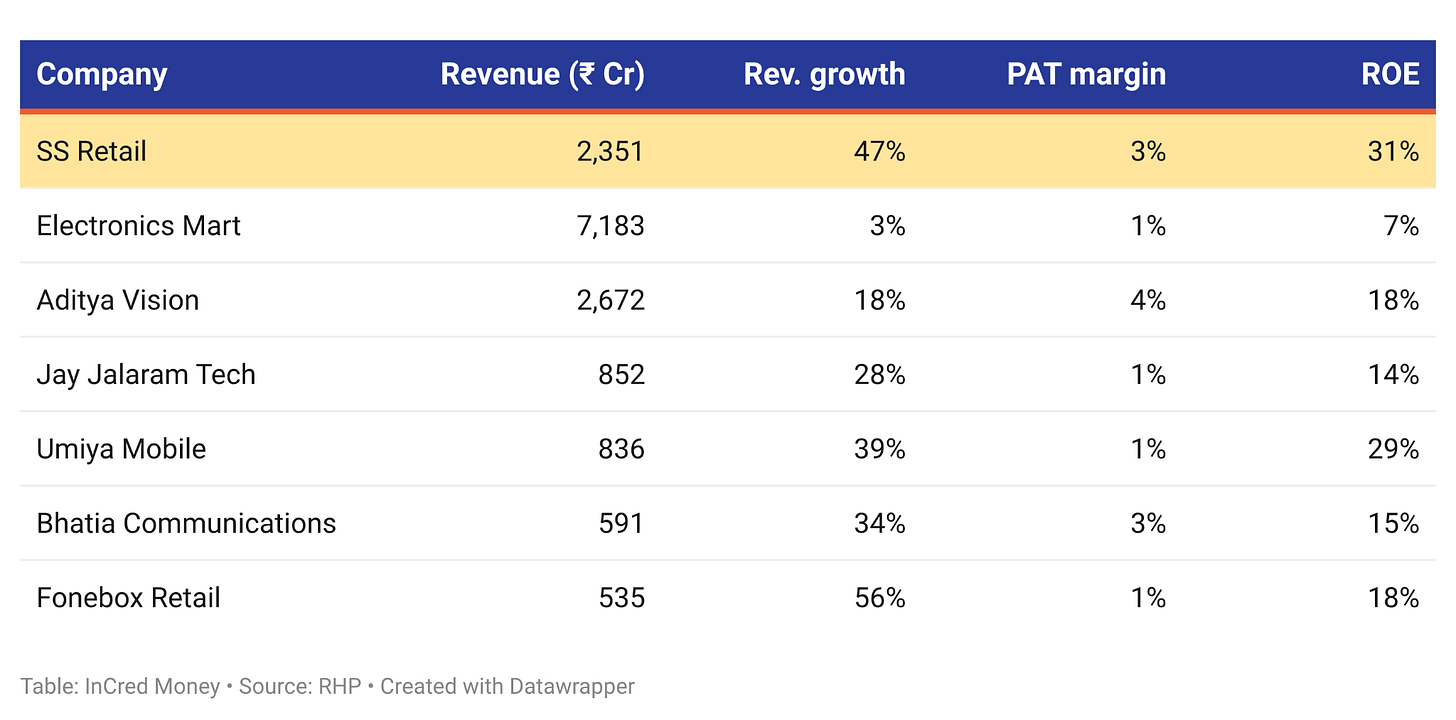
On revenue growth, SS Retail’s 47% expansion in FY26 trailed Fonebox Retail’s 56%, though on a far larger base.
Its ROE of 31% was the highest in the peer group.
Key Risks
Concentration in mobile phone sales: Mobile phones made up 86% of revenue from operations in FY26. Any slowdown in the mobile phone industry will affect SS Retail.
Geographic concentration in Maharashtra: As of March 31, 2026, 458 of the company’s 503 stores, or 91%, were in Maharashtra, which contributed 89% of revenue from operations in FY26 . This leaves the business exposed to any adverse political, social or economic shift.
Summary
The company operated 503 stores as of March 31, 2026, growing to 536 by July 31, 2026, and is the largest mobile phone retail chain in West India and in Maharashtra, and the third largest in India by store count.
Revenue grew at a 40% CAGR between FY24 and FY26 with steady increase in margins.
The business carries concentration risks which is typical of a regional retail chain: 86% of FY26 revenue came from mobile phones and 89% of revenue came from Maharashtra alone.
Net proceeds from the fresh issue are directed towards new store fit-outs and incremental working capital to fund continued expansion into Karnataka, Madhya Pradesh, Goa, Gujarat and, newly, Chhattisgarh.