Kanohar Electricals Limited is launching an IPO. The company runs a power transformer manufacturing and EPC business, designing, manufacturing and installing power transformers, traction transformers, shunt reactors and distribution transformers, alongside EPC works for substations and transmission lines.
IPO Summary

Introduction
India is building its power grid at a pace it has not seen before. In FY26 alone, the country added roughly 12,000 circuit kilometres of transmission lines, with 143,000 more circuit kms expected by FY32.
Every one of those lines needs a transformer at each end. Few Indian manufacturers can build the transformers that this build-out needs. In fact, only five companies in India held the short circuit test certification for 500 MVA, 400 kV transformers.
Kanohar Electricals Limited is one of them. The Meerut-based manufacturer has been in the transformer business for over 40 years.
They’re now going live in an IPO consisting of a Fresh Issue of ~₹300 Cr and an Offer for Sale of ~₹756 Cr from 8th to 10th Sep, 2026.
The Business Model
Kanohar runs two segments.:
- the Transformer Manufacturing business, making up ~83% of revenue in FY26, and
- the new EPC Business making up the remaining ~17%, split between EPC solutions for substations and for transmission lines.
On the transformer manufacturing side, the company makes:
- power transformers (up to 500 MVA and 400 kV),
- traction transformers and Scott transformers for Indian Railways,
- shunt reactors for renewable energy grids, and
- distribution transformers.
It runs two facilities in Meerut, Uttar Pradesh: the Rithani unit with 1,200 MVA capacity, and the Gangol unit with 18,000 MVA capacity, which is capable of making transformers up to 500 MVA and 400 kV.
Both facilities make their own transformer tanks and radiators in-house rather than buying them from outside vendors.
On the EPC side, Kanohar entered substation work in 2013 and transmission line work up to 400 kV in 2021.
Government entities dominate the customer base. Tenders awarded by central and state government bodies made up ~85% of the total revenue in FY26.
Kanohar’s bid-to-win ratio has been ~21%, meaning roughly one in five bids turns into an order.
Unit Economics (₹ per Order)

- Operating expenses have gone down from ~18% of the average order size in FY24 at ₹8 to ~11% in FY26 at ₹12.
- Though the number of orders won has diminished, the average order size has gone up, which is why EBITDA Margins continue to soar, with 28% margin in FY26, up from 11% in FY24.
Operating Metrics
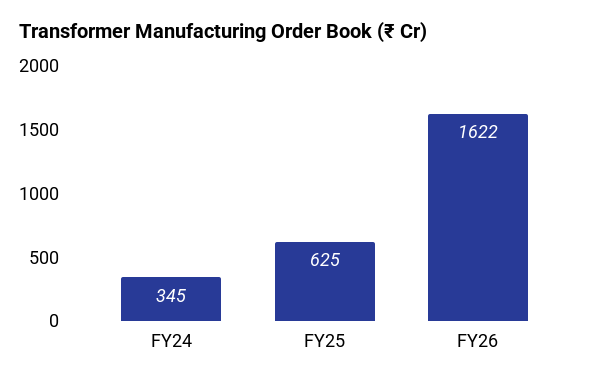
- Transformer Manufacturing now makes up 89% of the order book at ₹1,622 Cr, up from 58% two years ago at ₹345 Cr.
- Aggregate utilization across both units rose from 16% in FY24 to 46% in FY26, as the Gangol unit’s utilization climbed massively. The Rithani unit, though, remains almost entirely idle.


- Within Transformer Manufacturing, the highest voltage class (above 400 kV), saw the steepest gain in value, from ₹28 Cr in FY24 to ₹341 Cr in FY26.

The Financial Stuff

- Revenue from Operations grew from ₹277 Cr in FY24 to ₹654 Cr in FY26.
- Profit After Tax grew from ₹18 Cr in FY24 to ₹130 Cr in FY26, and EBITDA Margin more than doubled in the same period.
- Finance Costs and Depreciation still amount for a growing but still small amount of EBITDA, meaning most of it gets converted into PAT.
Peer Comparison, FY26

- Kanohar’s revenue At ₹654 Cr is the smallest in the set by a wide margin.
- Kanohar’s EBITDA Margin of 28% is the highest in the group, nearly double Schneider Electric’s 13%, and almost three times BHEL’s 10%.
- On PAT Margin, Kanohar’s 20% again leads the set by a wide margin, despite being the smallest company by revenue.
Key Risks
- Customer concentration: Top 10 customers made up 93% of revenue in FY26. One customer alone accounted for 31% of revenue in FY26.
- Fixed-price contract exposure: As of FY26, Kanohar had 35 active contracts, of which 4 were priced on a fixed basis rather than with price variation or escalation clauses. A sharp move in input costs during the life of those contracts cannot be passed on to the customer, and Kanohar alone has to bear it.
- Raw material supplier concentration: Copper and CRGO steel are Kanohar’s main inputs and their global prices are volatile. Top 10 suppliers accounted for 71% of the cost of raw materials.
- Dependence on government tenders: Revenue from government-awarded tenders was 85% of the total in FY26, and the bid-to-win ratio has stayed near one in five over three years.
- Geographic concentration: Rajasthan, Punjab, and Gujarat together made up 52% of FY26 revenue. A slowdown in transmission spending in any one of these states would have an outsized effect on the business.
Conclusion
Kanohar sells into a grid build-out that India’s government has committed to for years to come, and it holds a certification that only four other Indian companies can match. Its margins have widened fast, its order book has more than doubled, and it carries little debt. Customer concentration and reliance on government tenders are the two risks worth watching.